
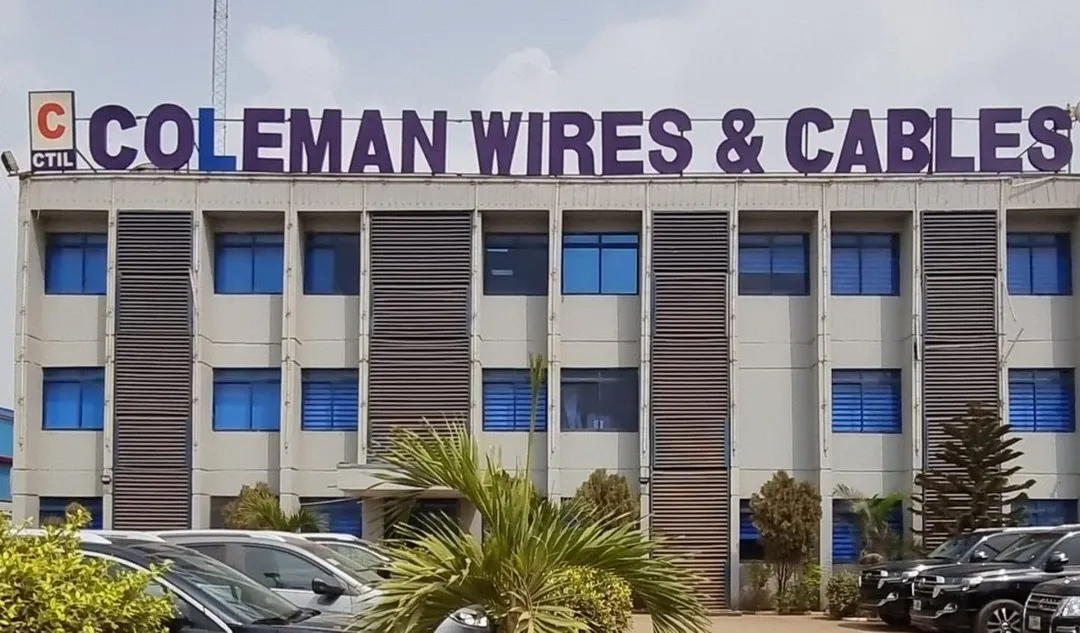
# The Invisible Giant Wiring Africa's Future: How Coleman Wires & Cables Is Building a Nigerian Industrial Powerhouse
From a modest wire-manufacturing business in 1975 to a major force in electrical cables, power transmission and fibre-optic production, the story of Coleman Technical Industries Limited reveals what happens when an African company decides to manufacture the infrastructure that powers modern life.
Imagine a new residential estate in Lagos.
The buildings are ready. The walls have been plastered. The electricians are installing fittings, sockets, distribution boards and light fixtures. Somewhere in the same development, engineers are connecting the power distribution system. A telecommunications contractor is preparing the infrastructure that will bring high-speed internet into the estate.
Most people will notice the beautiful lighting, the air conditioners, the security systems and the internet connection.
Very few will think about the cables running behind the walls, beneath the ground and across the streets.
Yet without those cables, much of what makes the development functional would simply not work.
Now move away from the residential estate.
Think about a manufacturing plant, an offshore oil installation, a solar farm, a hospital, a data centre or a national electricity transmission network.
They all depend on something that rarely receives the attention given to the finished project: reliable electrical and communication cables.
This is where the story of Coleman Technical Industries Limited (CTIL), popularly known as Coleman Wires and Cables, becomes fascinating.
The Nigerian company has spent decades building an industrial business around products most consumers rarely see but modern economies cannot function without.
It manufactures the electrical infrastructure used in homes, commercial buildings, industrial facilities, power networks, oil and gas operations and telecommunications.
Its journey is especially interesting because it demonstrates how a locally owned Nigerian company can move beyond basic manufacturing, invest in specialised technology, develop backward integration and position itself in industries that will influence Africa's future.
Coleman's story is not merely about producing wires.
It is about manufacturing the connections that keep economies moving.
And that is a much bigger business.
The beginning: A Nigerian industrial vision that started in 1975#
Coleman Technical Industries Limited was incorporated on July 1, 1975.
Its founder, Asiwaju Solomon Kayode Onafowokan, had a vision centred on developing local manufacturing capacity, creating employment and producing electrical wires and cables that could serve Nigerian industries and households.
However, incorporation and actual manufacturing did not happen at the same time.
The company commenced cable production in 1996, beginning operations at its Ikotun factory in Lagos.
Its early annual processing capacity was approximately:
- 1,200 metric tonnes of copper.
- 800 metric tonnes of aluminium.
For a company that would eventually develop multiple large-scale manufacturing facilities, those beginnings were modest.
But the important thing was that Coleman had entered a technically demanding industrial market.
Cable manufacturing is not simply about joining metal wires together and covering them with plastic.
It requires engineering knowledge, metallurgy, insulation technology, production precision, testing and quality assurance.
A cable must be designed for the electrical load and environment in which it will operate. Its conductor, insulation, dimensions and protective layers all matter.
A mistake in the manufacturing process can affect performance, reliability and safety.
Coleman therefore entered a business in which manufacturing consistency and technical credibility would be just as important as production capacity.
And over time, the company began investing accordingly.
From a Lagos factory to a major manufacturing footprint#
One of the most important turning points in Coleman's history came in 2009, when it commissioned a major manufacturing facility at Arepo, Ogun State, along the Lagos-Ibadan Expressway.
The company describes the Arepo factory as the largest cable-manufacturing factory in West Africa at the time of its commissioning.
Its original installed processing capacity was reported at 8,000 metric tonnes of copper and 4,000 metric tonnes of aluminium annually.
The expansion represented a major increase from the company's early manufacturing capacity.
But Coleman was not finished.
In December 2014, it commissioned its Sagamu facility in Ogun State.
This plant was established to manufacture medium- and high-voltage XLPE cables.
XLPE means cross-linked polyethylene, a type of insulation material widely used in power cables because of its electrical and thermal properties.
Why was this development important?
Because there is a significant difference between producing ordinary building wires and manufacturing specialised cables for power distribution and transmission.
A cable used in a residential building does not necessarily have the same design requirements as a cable used in an industrial power network.
Higher-voltage applications require more specialised engineering, insulation systems, testing procedures and manufacturing capabilities.
By developing the Sagamu facility, Coleman strengthened its position in a more technically demanding segment of the market.
It was no longer competing only in the everyday building-wire category.
It was moving further into the infrastructure business.
The backward-integration strategy: Why Coleman moved closer to its raw materials#
Here is where the company's strategy becomes particularly interesting.
Copper and aluminium are among the most important raw materials used in electrical cable manufacturing.
Copper offers excellent electrical conductivity, while aluminium is widely used in applications where its lower weight and other engineering characteristics are advantageous.
But manufacturers that depend heavily on external suppliers of these materials can face significant challenges.
International commodity prices fluctuate.
Exchange rates change.
Shipping costs rise.
Supply chains become disrupted.
Import restrictions and delays can affect production schedules.
A manufacturer may have enough orders but struggle to obtain the materials needed to fulfil them.
Coleman recognised that controlling more of its raw-material supply chain could improve its resilience.
From around 2020, the company advanced its backward-integration programme, involving copper and aluminium processing and smelting.
The objective was to move further upstream in the manufacturing process.
Rather than depending entirely on purchased raw materials, Coleman could build greater internal capability around the metals required for its cable products.
The Sagamu industrial complex has since been reported to include copper and aluminium smelting facilities.
This is a significant strategic move.
Consider the difference between two manufacturers.
The first buys nearly all its processed metal from external suppliers before manufacturing cables.
The second has developed additional capabilities to process important raw materials and convert them into products for its own manufacturing operations.
The second manufacturer may have more control over its supply chain, although it must also manage the cost, operational complexity and capital requirements of running those additional facilities.
Backward integration is not automatically cheaper.
It is valuable when the economics, reliability and strategic benefits justify the investment.
For Coleman, the ambition is clear: strengthen local industrial capability and reduce exposure to external supply dependencies.
# What exactly does Coleman manufacture?
For anyone who has never worked in electrical engineering, the cable industry can appear complicated.
There are many different products, and they are not interchangeable.
A cable designed for a house may be completely unsuitable for a high-voltage transmission project.
Coleman's product portfolio covers more than 30 product lines, according to Agusto & Co.'s company assessment.
The company's product catalogue includes several important categories.
1. Building wires#
These are the electrical wires used in residential, commercial and industrial buildings.
They carry electricity to lighting points, sockets, appliances and other electrical installations.
Common product variations include:
- Single-core solid wires.
- Single-core stranded wires.
- Flexible cables.
- Surface-flat cables.
- Earthing cables.
Imagine the wiring inside a typical Nigerian home.
The cables connecting the distribution board to lighting points and sockets are part of the infrastructure that makes the building functional.
This is one of the most familiar applications of cable manufacturing.
2. Low-voltage cables#
Low-voltage cables are used in electrical distribution applications up to 1 kilovolt.
They are found in residential, commercial and industrial environments.
Depending on the application, they may be armoured or unarmoured.
Armouring provides an additional mechanical-protection layer for cables used in installations where they may be exposed to physical stress or other external risks.
3. Fire-resistant and flame-retardant cables#
This is a particularly important product category.
In buildings, certain electrical and safety systems may need to continue functioning during a fire for a specified period.
Fire-resistant cables are designed to maintain circuit integrity under defined fire conditions so that critical systems, such as emergency lighting, alarms and fire pumps, can continue operating.
Flame-retardant cables are designed to limit the spread of flame under specified test conditions.
These are related but different performance properties.
The distinction matters because a cable being flame-retardant does not automatically mean it can continue operating during a fire.
For hospitals, commercial buildings, industrial facilities and other critical infrastructure, selecting the correct cable specification is essential.
4. Control cables#
Control cables transmit signals used to operate machinery, industrial equipment and automated systems.
They are particularly relevant in factories, production lines and industrial facilities.
A manufacturing plant contains machines that must communicate with control systems.
Control cables help carry the signals that coordinate this equipment.
Without reliable control wiring, complex industrial operations can become unreliable.
5. Instrumentation cables#
Instrumentation cables are used to transmit signals between measuring instruments, control systems and industrial equipment.
They are important in environments where accurate measurement and communication are necessary.
Examples include oil and gas installations, process plants and industrial automation systems.
These cables may need to resist electromagnetic interference, mechanical stress and environmental conditions depending on their design.
6. Medium- and high-voltage cables#
These cables are designed for more demanding electrical distribution and power infrastructure applications.
They are used in power networks, industrial installations and other projects where electricity must be transferred at higher voltage levels.
Coleman's Sagamu investment in XLPE cable manufacturing positioned the company in this specialised category.
7. Overhead transmission cables#
Electricity does not reach communities simply because generating stations produce power.
It must be transmitted and distributed through a network of infrastructure.
Overhead conductors are a major part of that system.
Coleman lists several conductor types, including:
- AAC — All Aluminium Conductor.
- ACSR — Aluminium Conductor Steel Reinforced.
- ACCC — Aluminium Conductor Composite Core.
- GAP conductors.
- Other specialised transmission conductors.
These products serve different engineering requirements.
For example, ACSR conductors combine aluminium strands with a steel reinforcing core, while ACCC conductors use a composite core designed for specific strength and performance advantages.
The ability to manufacture specialised overhead transmission conductors is strategically important for electricity grid development and modernisation.
8. Solar cables#
The expansion of solar energy creates demand for cables specifically designed for photovoltaic installations.
Solar cables connect important components of a solar power system, including photovoltaic modules and other electrical equipment.
They must be designed for the environmental and electrical conditions associated with solar installations.
This gives cable manufacturers exposure to the renewable-energy market.
9. Submersible and marine cables#
Some electrical installations operate in demanding environments.
Submersible cables are designed for applications involving submerged equipment, such as certain pumps.
Marine cables are designed for electrical systems operating in marine environments.
These applications require specialised construction and materials appropriate to the intended operating conditions.
10. Fibre-optic and communication cables#
Here is where Coleman's story moves beyond electricity.
Fibre-optic cables transmit information using light through optical fibres.
They are a critical part of modern telecommunications infrastructure.
They support:
- Broadband internet.
- Telecommunications networks.
- Data transmission.
- Enterprise connectivity.
- Digital infrastructure.
- High-capacity communication links.
A country can have mobile phones, internet service providers and data centres, but without adequate fibre infrastructure, expanding reliable high-capacity connectivity becomes more difficult.
Coleman's move into fibre-optic cable manufacturing therefore represents an important diversification of its business.
It is no longer only participating in the infrastructure that carries electricity.
It is also participating in the infrastructure that carries information.
# The fibre-optic ambition: Coleman enters Africa's digital infrastructure story
One of the most significant developments in Coleman's recent history was its entry into fibre-optic cable manufacturing.
The company records 2022 as the year it commissioned West Africa's first fibre-optic cable manufacturing plant.
The development was significant because fibre optics are a strategic component of telecommunications infrastructure.
Think about what happens when someone makes a video call from Lagos to London.
Or when a bank processes thousands of digital transactions.
Or when a company operates cloud-based software across several countries.
The information travels through complex networks involving fibre-optic cables, telecommunications equipment, data centres and other infrastructure.
Fibre is not the only technology involved, but it is one of the most important foundations of high-capacity digital connectivity.
Coleman subsequently expanded its fibre-optic operations.
In October 2025, the Federal Government inaugurated a new fibre-optic manufacturing facility at Sagamu, Ogun State.
The expansion was reported to include a reinforced plastic production line.
Coleman's own published technical description identifies the second phase with a capacity specification of approximately 9 million fibre counts per kilometre and 180,000 cable-kilometres.
These are production-capacity specifications, not evidence that the plant has already sold or manufactured that entire volume.
That distinction matters.
Installed capacity describes what a facility is designed to produce under specified operating conditions.
Actual production depends on orders, raw-material availability, utilisation, staffing, equipment performance and market demand.
Nevertheless, the expansion represents a significant investment in local digital infrastructure manufacturing.
It also creates an opportunity for Nigeria to participate more deeply in the supply chain supporting broadband and telecommunications development across Africa.
For Coleman, fibre optics could become an important second growth engine alongside electrical cables.
# The business leadership behind the expansion
A company's history is shaped not only by machines and factories but also by the people making strategic decisions.
Coleman is chaired by Asiwaju Solomon Kayode Onafowokan, the entrepreneur identified in public business reporting as its founder.
He has more than five decades of corporate management experience and previously served as Deputy Chief Executive at Chellarams Plc.
He has also held leadership positions within important Nigerian business organisations, including the Lagos Chamber of Commerce and Industry.
The company's Managing Director and Chief Executive Officer is George Olutope Onafowokan.
He has an accounting and finance background and has been closely associated with the company's manufacturing expansion, including its development of high-voltage XLPE and fibre-optic cable facilities.
Another important technical leader is Engr. Michael Olusegun Onafowokan, the Executive Director responsible for production and technical operations.
His engineering background and involvement in production expansion reflect the importance of technical leadership in a manufacturing business.
This is worth emphasising.
In technology-driven manufacturing, commercial leadership alone is not enough.
The organisation also needs people who understand engineering, production processes, quality assurance, raw-material chemistry, machinery, testing and industrial safety.
A company may have the financial resources to purchase equipment.
But it still needs the technical capability to operate that equipment efficiently and consistently.
# Quality and certifications: Why cable manufacturing is a business of trust
Imagine two contractors bidding for the electrical installation of a hospital.
Both present attractive prices.
Both promise to deliver on schedule.
Both claim their products are reliable.
But the project involves critical electrical systems.
The procurement team must look beyond marketing claims.
It needs to assess product specifications, applicable standards, test results, certification, traceability and the manufacturer's ability to deliver consistently.
That is why quality assurance matters so much in the cable industry.
Coleman reports receiving its maiden Nigerian Industrial Standard and Standards Organisation of Nigeria certifications in 2002.
Its quality-assurance materials also display standards and certificates including:
- ISO 9001:2015 for quality management systems.
- ISO/IEC 17025:2017 for laboratory competence.
- ISO 14001-related environmental management certification.
- ISO 45001-related occupational health and safety certification.
- CE-related conformity documentation for applicable products.
A crucial distinction is necessary here.
A company's management-system certification is not the same as a product certificate.
ISO 9001, for example, relates to quality-management systems. ISO/IEC 17025 concerns the competence of testing and calibration laboratories.
Neither one automatically means every cable in a manufacturer's catalogue has been certified for every possible application.
Project owners, engineers, electrical contractors and procurement teams must still verify the precise product standard, certificate scope, test documentation and validity applicable to the cable they intend to purchase.
This is not a small technical detail.
Electrical cable quality is directly connected to safety and reliability.
A cable that is incorrectly specified, undersized, poorly manufactured or improperly installed can create serious problems.
For Coleman, a strong quality system is therefore not merely a branding advantage.
It is a business necessity.
# The financial credibility question: What do independent credit ratings say?
Coleman is a privately held company rather than a publicly listed company with the same level of continuous financial disclosure as a company quoted on the Nigerian Exchange.
That makes it important to distinguish what is publicly verifiable from what is not.
There is no reason to invent annual revenue, net profit or market valuation figures simply to make the company's story sound impressive.
However, independent credit-rating assessments provide useful information about the company's financial position and ability to meet its obligations.
In May 2026, GCR Ratings affirmed Coleman's national-scale ratings at:
- A-(NG) for its long-term issuer rating.
- A2(NG) for its short-term issuer rating.
- Stable outlook.
Agusto & Co. also affirmed its ratings at:
- A for the long-term issuer rating.
- A1 for the short-term issuer rating.
- Stable outlook, with the rating expiry stated as June 30, 2027.
These are credit ratings.
They assess an issuer's creditworthiness and ability to meet financial obligations. They are not ratings of cable quality, product safety or investment returns.
It is also important not to treat ratings from different agencies as directly interchangeable. Each agency applies its own methodology and rating scale.
What makes the ratings interesting?#
Agusto's assessment identified several positive factors:
- Coleman's established position in the Nigerian wire and cable industry.
- Demand for its products across construction, power, oil and gas, and telecommunications.
- Its manufacturing capacity.
- Its ability to service debt, with an EBITDA interest-coverage ratio of 2.8 times in financial year 2025.
EBITDA interest coverage measures how many times earnings before interest, taxes, depreciation and amortisation can cover interest expenses.
In simple terms, it provides an indication of how comfortably a business can pay the interest on its borrowings from its operating earnings.
But Agusto also identified important risks:
Rising debt: Expansion requires capital, and additional borrowing can increase financial pressure.
Working-capital requirements: Manufacturers must finance raw materials, inventories, production and customer receivables.
Commodity-price exposure: Copper and aluminium prices can change, affecting production costs and margins.
Loss of an important oil and gas contract: Agusto noted that discontinued supply arrangements had previously contributed to sales volumes and revenue margins.
This is an important reminder.
A company can have impressive factories, strong product recognition and significant installed capacity while still facing financial risks.
Manufacturing success is not measured by factory size alone.
It also depends on how efficiently the company converts capital, raw materials and labour into cash-generating products.
# The real opportunity: Nigeria needs infrastructure, and infrastructure needs cables
Coleman's long-term opportunity is closely connected to the needs of the Nigerian and African economies.
Consider the areas in which its products are used.
Electricity transmission and distribution#
Power generation is only one part of an electricity system.
Electricity must also be transmitted over long distances and distributed to homes, commercial buildings and industrial facilities.
That requires conductors, distribution cables, substations, transformers and other infrastructure.
As electricity networks are expanded, repaired and modernised, demand for appropriate cables and conductors becomes an important part of the supply chain.
Housing and construction#
Every new residential building, shopping complex, hospital, school, factory and office development requires electrical wiring.
The growth of real estate and commercial infrastructure therefore creates opportunities for cable manufacturers.
Oil and gas#
The oil and gas industry relies on specialised electrical and instrumentation systems.
Industrial facilities require equipment that can operate under demanding environmental and technical conditions.
This creates demand for specialised cable products rather than ordinary building wires.
Renewable energy#
Solar projects, mini-grids and other renewable-energy installations require suitable electrical cables.
As distributed energy becomes more important to homes and businesses, manufacturers capable of supplying compliant solar and power cables can participate in the expansion.
Telecommunications and broadband#
The demand for digital connectivity requires infrastructure.
Fibre-optic cables are an important part of that infrastructure.
Telecommunications companies, broadband operators, data-centre developers and other network providers need reliable fibre networks to support increasing data traffic.
This is where Coleman's decision to invest in fibre-optic manufacturing could become strategically significant.
The company is participating in two infrastructure markets that are increasingly interconnected:
The infrastructure that carries power and the infrastructure that carries information.
# Coleman's competitive advantage: More than a locally manufactured product
It is tempting to assume that a Nigerian manufacturer automatically has a competitive advantage simply because its products are made locally.
That is not enough.
Local production must be supported by competitive pricing, dependable quality, technical capacity, delivery performance and customer confidence.
Coleman's potential advantages can be understood through several connected capabilities.
1. Manufacturing scale#
Agusto & Co.'s 2026 rating assessment reports that Coleman operates manufacturing facilities at Arepo and Sagamu, with installed annual capacity of approximately:
| Material | Installed annual capacity |
|---|---|
| Copper conductors | 130,000 metric tonnes |
| Aluminium conductors | 48,000 metric tonnes |
These are installed capacity figures, not confirmed annual output or sales volumes.
The distinction is important because a factory operating at 50% utilisation will not produce the same volume as one operating at 90%.
Nevertheless, the figures indicate the scale of the company's industrial footprint as assessed by the rating agency.
2. Product diversity#
With more than 30 product lines, Coleman serves several markets rather than depending on a single cable category.
This can reduce reliance on one end-market, although it also makes inventory planning, product management and technical support more complex.
3. Backward integration#
Its investments in copper and aluminium processing can help strengthen control over important inputs.
The financial benefit depends on production efficiency, procurement economics, energy costs and the ability to utilise the facilities effectively.
4. Technical specialisation#
The company's investment in XLPE, transmission and fibre-optic products moves it into more specialised categories.
These segments require equipment, technical knowledge and testing capabilities that cannot be replicated simply by buying ordinary cable-making machinery.
5. Distribution#
A manufacturer needs more than a factory.
It needs a route to its customers.
Coleman reports operating a distribution network across Nigeria and selected West African markets.
The effectiveness of that network will influence product availability, delivery costs and market reach.
# The challenges: What could slow down Coleman's growth?
A balanced business analysis must examine the difficult parts of the story.
Coleman operates in an industry with significant opportunities, but it also faces risks that could influence its future.
1. Copper and aluminium price volatility#
Copper and aluminium are globally traded commodities.
Their prices can change because of supply disruptions, demand conditions, energy costs, geopolitical developments and currency movements.
For a cable manufacturer, these changes can affect production costs and the selling prices of finished products.
The company must manage procurement, inventories, pricing and customer contracts carefully.
2. Foreign-exchange exposure#
Even manufacturers with local factories may depend on imported machinery, specialised components, raw materials or technical inputs.
Currency volatility can therefore affect capital expenditure and operating costs.
Backward integration may reduce some external dependencies, but it does not automatically eliminate foreign-exchange risk.
3. Debt and working capital#
Large industrial facilities require capital.
Machines must be purchased and maintained. Raw materials must be stocked. Employees must be paid. Finished products may remain in inventory before customers pay.
This creates significant working-capital requirements.
Agusto's 2026 assessment specifically highlighted rising debt and increased working-capital pressure.
Coleman's expansion therefore needs to generate enough operating cash flow to support the business without placing excessive strain on its balance sheet.
4. Capacity utilisation#
Installed capacity is not the same as production.
A company may have the machinery to produce large volumes but still operate below capacity because of insufficient demand, raw-material shortages, power costs, maintenance downtime or other operational constraints.
The commercial objective is to keep factories productively utilised while maintaining quality and profitability.
5. Competition#
Coleman operates in a market that includes other Nigerian and international cable manufacturers.
Its competition is not limited to companies producing identical products.
Depending on the category, customers may consider imports, alternative suppliers and manufacturers with different technical specifications.
Quality, price, delivery, certification and technical support will all influence purchasing decisions.
6. Technology and product innovation#
Electrical and telecommunications infrastructure continues to evolve.
Renewable energy, modern transmission networks, electric mobility, data centres and expanding broadband infrastructure create changing technical requirements.
Manufacturers must continually invest in research, machinery, testing and product development if they want to remain competitive.
A factory that is technologically advanced today can become outdated if its owner stops innovating.
# The brand strategy: How Coleman can become more than a cable manufacturer
This is where Coleman's story becomes especially relevant to business owners, entrepreneurs and brand strategists.
A cable manufacturer operates in a market where the final consumer may never see the product after installation.
That creates a unique branding challenge.
A person may recognise the name of a smartphone manufacturer, a bank or a supermarket because they interact with those brands regularly.
But electrical cables are often hidden inside walls, installed underground or mounted high above roads.
The buyer may be an electrical contractor, engineer, distributor, procurement officer, developer or government agency rather than the person who eventually uses the building.
This makes Coleman a business-to-business (B2B) industrial brand.
Its brand value must be demonstrated through more than advertising.
It must be demonstrated through:
- Product performance.
- Quality certification.
- Independent testing.
- Engineering support.
- Delivery reliability.
- Technical documentation.
- Customer service.
- Consistency across projects.
For Coleman, the most valuable brand promise is not simply that its products are Nigerian-made.
It is that its locally manufactured products can meet the technical requirements of demanding applications.
That is a stronger commercial message.
Local identity, international ambition#
Coleman is an indigenously owned Nigerian company.
Its public brand positioning emphasises local manufacturing, industrial development and international quality expectations.
This gives the company an opportunity to occupy an interesting position:
A Nigerian industrial brand with a regional and potentially wider African market.
But the opportunity must be earned through consistent delivery.
A Nigerian manufacturer does not become globally competitive simply by describing itself as world-class.
It becomes competitive when its products meet the required standards, customers trust its performance, and its operations can deliver reliably across different markets.
That is where technical proof becomes a brand asset.
# What African entrepreneurs can learn from Coleman
Coleman's journey offers lessons that extend far beyond the cable industry.
Its story is relevant to entrepreneurs building businesses in manufacturing, technology, agriculture, infrastructure, consumer goods and industrial services.
1. Start with an essential problem#
Coleman entered a market connected to a fundamental economic need: reliable electrical wiring and power infrastructure.
Businesses built around essential needs can create long-term demand.
Entrepreneurs should study the problems that households, businesses and governments cannot simply ignore.
Energy, food, transportation, healthcare, housing, communication and industrial productivity all create opportunities for companies that can deliver reliable solutions.
2. Build manufacturing capability, not just trading relationships#
Trading can generate revenue, but manufacturing can build additional industrial capabilities.
A manufacturer develops production knowledge, technical expertise, equipment, quality processes and the ability to create products suited to customer requirements.
This does not mean trading is an inferior business model.
It means manufacturing can create a different kind of competitive advantage when the investment is commercially sustainable.
3. Move up the value chain#
Coleman's backward-integration strategy is an important example.
Rather than concentrating only on the final cable, the company invested in capabilities connected to its copper and aluminium inputs.
African businesses should continually examine where they are positioned in their value chains.
Can they improve sourcing?
Can they process raw materials?
Can they develop specialist components?
Can they reduce unnecessary dependence on external suppliers?
The opportunity may lie in participating in more stages of the value chain.
4. Diversify through related capabilities#
Coleman's move from electrical cables into fibre-optic manufacturing is strategically interesting because it builds on its existing industrial capabilities.
The company already had experience in manufacturing conductors, handling industrial machinery and serving infrastructure customers.
Fibre optics represent a different technical product, but they connect naturally with the broader infrastructure market.
The lesson is to pursue diversification where existing knowledge, customers and capabilities can create an advantage.
5. Invest in technical knowledge#
In industrial manufacturing, machines alone are not enough.
Businesses need engineers, production specialists, quality-control professionals, laboratory personnel and experienced operators.
Technical knowledge must become part of the organisation's culture.
Otherwise, the company risks buying expensive equipment without developing the expertise to use it effectively.
6. Treat quality as a commercial strategy#
Quality is not merely a regulatory requirement.
It can influence customer retention, contract opportunities, product reputation and the ability to enter new markets.
Coleman's investment in certifications, laboratory capabilities and quality assurance demonstrates the importance of making technical credibility part of the business.
7. Expand with financial discipline#
Factories, equipment, new products and raw-material facilities require money.
Expansion can create future revenue, but it can also increase borrowing, inventory and operating costs.
Coleman's credit-rating assessments show why capital expenditure must be matched with financial discipline.
A company must not only be able to build new facilities.
It must be able to operate them profitably.
8. Build a brand around proof#
In technical industries, customers are not persuaded by impressive slogans alone.
They need evidence.
Specifications, product testing, technical documentation, certifications and reliable project execution all contribute to trust.
A strong industrial brand makes it easy for buyers to verify why its products deserve consideration.
9. Think about the next infrastructure revolution#
Coleman's expansion into fibre optics shows the value of identifying adjacent markets early.
The future of Africa will require more than electricity cables.
It will require fibre networks, solar infrastructure, modern transmission systems, data centres, industrial automation and reliable communication systems.
Entrepreneurs should identify where their existing capabilities can serve emerging infrastructure needs.
10. Build a company that outlives its founder#
Coleman's history stretches back to 1975.
An enduring business must develop systems, governance, leadership, talent and institutional knowledge that can survive beyond the people who started it.
A founder may create the original vision.
The organisation must develop the capabilities to sustain it.
# BrandKabal's Final Take
Coleman Technical Industries Limited is an important example of Nigerian industrial ambition.
It began with electrical wire manufacturing and gradually expanded into a much broader business covering building wires, low-voltage cables, high-voltage cables, transmission conductors, industrial cables and fibre-optic products.
It invested in major manufacturing facilities at Arepo and Sagamu.
It developed medium- and high-voltage XLPE manufacturing capabilities.
It moved further upstream into copper and aluminium processing.
It entered fibre-optic production and expanded its digital-infrastructure ambitions in 2025.
Its credit ratings and manufacturing footprint demonstrate that the company has built meaningful capabilities in a technically demanding industry.
But its next chapter will require more than expanding factory capacity.
The company must manage commodity-price volatility, foreign-exchange exposure, debt, working capital, capacity utilisation and competition.
It must ensure that its expansion into fibre optics creates sustainable commercial returns.
And it must continue strengthening the quality, technical reliability and customer confidence associated with its brand.
For African entrepreneurs, however, the biggest lesson is much larger than cable manufacturing.
Do not only build businesses around what customers can see. Build businesses around the infrastructure that makes everything else possible.
The next great African industrial brands may not all be consumer-facing companies.
Some will manufacture the components behind electricity networks, telecommunications systems, factories, transport infrastructure and the digital economy.
Their products may never become household conversation.
But their importance will be felt in almost every household.
Coleman started with a simple industrial proposition: manufacture wires and cables locally.
Today, its ambitions extend into the infrastructure of both energy and connectivity.
That is the story of a company that understood something many businesses overlook:
Sometimes, the most valuable position in an economy is not at the centre of attention. It is at the centre of everything that works.
BrandKabal's 10 Big Lessons from Coleman Wires & Cables#
1. Build around essential needs. Businesses that serve critical economic requirements can create enduring opportunities.
2. Think beyond the first product. A manufacturing business can grow by developing related capabilities and serving adjacent markets.
3. Control strategic parts of your supply chain. Backward integration can strengthen resilience when supported by sound economics.
4. Invest in technical expertise. Industrial growth requires engineers, specialised employees and a culture of continuous improvement.
5. Make quality part of your brand identity. Trust must be supported by testing, standards and consistent product performance.
6. Diversify with purpose. Moving into fibre optics makes strategic sense because it connects with Coleman's wider infrastructure capabilities.
7. Manage expansion carefully. Increased production capacity must translate into productive utilisation and healthy cash flow.
8. Understand your commodity exposure. Raw-material price changes can influence manufacturing costs and margins.
9. Sell proof, not just promises. Industrial buyers need specifications, certification, technical support and dependable delivery.
10. Build institutions that outlive their founders. Long-term success depends on systems, people, governance and institutional knowledge.
The BrandKabal Question#
Imagine Nigeria's electricity network, industrial facilities and telecommunications infrastructure are entering a new era of expansion.
Would you rather build a business that sells finished products to customers, or one that manufactures the essential components other businesses need to build their own products and infrastructure?
Coleman's journey suggests that the second opportunity can be substantial — provided the company has the technical expertise, capital discipline, quality systems and commercial relationships to deliver.
Because the companies that shape tomorrow's economy will not always be the ones consumers see first.
Some will be the companies quietly manufacturing what makes tomorrow possible.
Editorial and fact-check note#
This article uses Coleman Technical Industries Limited's published company history, product information, leadership profiles and quality-assurance materials; the Bank of Industry's 2024 annual report; Agusto & Co.'s 2026 credit-rating assessment; GCR Ratings' May 2026 rating announcement; and reporting on the Federal Government's October 2025 inauguration of the Sagamu fibre-optic facility.
Coleman is a privately held company. This article therefore does not invent a revenue figure, net profit, market capitalisation or valuation where comparable public financial disclosures were not available.
The installed capacity figures of 130,000 metric tonnes of copper conductors and 48,000 metric tonnes of aluminium conductors are those reported in Agusto & Co.'s 2026 assessment. Installed capacity is not the same as actual annual production or sales. Earlier company and Bank of Industry materials give different capacity figures, reflecting different reporting dates and descriptions of the facilities.
Credit ratings are assessments of issuer creditworthiness. They should not be confused with product certifications or guarantees of future financial performance.


Join the conversation