
Comparing Brand Equity, User Retention, and Trust Signals in Nigeria’s Neobanking Revolution#
Imagine a young Nigerian standing in front of two doors.
Behind the first door is a bank.
Behind the second is a savings box.
He needs both.
He needs somewhere to receive money, transfer money, pay bills, use a card and occasionally borrow.
But he also knows himself.
If the money remains in his spending account, there is a good chance he will spend it.
So he needs something else — a platform that can help him resist himself.
That small behavioural distinction explains much of the fascinating rivalry between Kuda and PiggyVest.
Kuda largely entered the market asking:
“What if banking could happen entirely from your phone?”
PiggyVest effectively asked:
“What if technology could help Nigerians actually keep money?”
Both became powerful fintech brands.
But they did not build exactly the same kind of relationship with the customer.
And that is where the real story begins.
Kuda vs. PiggyVest at a Glance#
| Dimension | Kuda | PiggyVest |
|---|---|---|
| Core proposition | Digital banking | Saving, investing & financial discipline |
| Primary behaviour | Spend, send, receive, manage | Save, lock, invest, grow |
| Regulatory foundation | CBN-licensed microfinance bank; NDIC-insured deposits | Savings/investment ecosystem with SEC-regulated fund-management infrastructure |
| User scale | 8+ million customers, according to Kuda | 6+ million active users, according to 2026 reporting |
| Brand personality | Modern, youthful, convenient | Disciplined, relatable, financially aspirational |
| Strongest trust signal | Banking licence + NDIC insurance + transaction infrastructure | Longevity + user payouts + regulated investment structure + financial-discipline culture |
| Retention engine | Everyday financial utility | Financial goals and behavioural commitment |
| Major strength | Frequency of use | Depth of savings relationship |
| Major strategic challenge | Turning frequent transactions into deeper loyalty | Expanding beyond savings without diluting its core trust proposition |
Kuda’s current website says it has over 8 million customers, while reporting on PiggyVest in 2026 puts the platform at more than 6 million active users. These figures should not be treated as an apples-to-apples comparison because the companies use different terminology and may measure their customer bases differently.
1. Kuda: The Brand That Tried to Make Banking Feel Like an App#
When Kuda entered Nigeria’s financial technology conversation, its proposition was almost rebellious in its simplicity.
Why should a customer need to visit a banking hall to perform something that a smartphone could theoretically accomplish in seconds?
Kuda positioned itself around digital-first banking.
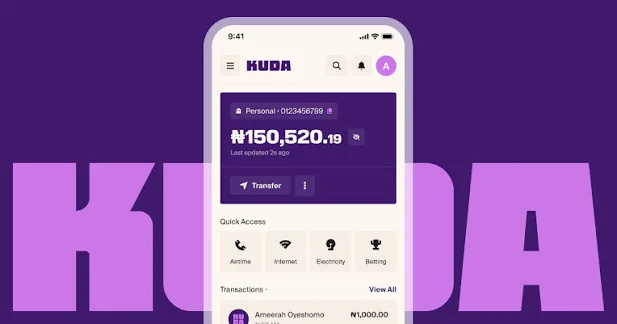
Today, the company describes itself as a digital bank built for Nigerians, offering transfers, savings, cards, investments, borrowing, bill payments and business banking.
But Kuda’s brand equity wasn’t built simply because it offered banking services.
It was built around removing friction.
No traditional banking hall.
No paper-heavy experience.
No long queues for ordinary transactions.
A smartphone became the branch.
And that was a powerful brand idea.
2. Kuda’s Scale Is No Longer Just a Marketing Story#
The numbers tell an interesting story.
Kuda reported 4.9 million registered app users in 2022.
By 2023, that number had increased to 7.2 million, representing approximately 47% growth year over year. Its group revenue reached $32.1 million in 2023, up from $21.5 million in 2022.
Then came another important operational signal.
In Q1 2025, Kuda reported processing more than 300 million transactions worth ₦14.3 trillion (about $9.3 billion) across its retail and business banking operations. Retail banking accounted for ₦8.5 trillion (about $5.5 billion), while business customers accounted for ₦5.8 trillion (about $3.7 billion).
That number matters for brand analysis.
Why?
Because registered users are not the same thing as active customers.
Someone can download an app once and disappear.
Transaction frequency is a stronger behavioural signal.
A customer who repeatedly receives money, pays bills, transfers funds, uses a card and manages expenses is demonstrating that the product has become part of their financial routine.
And routine is one of the foundations of retention.
3. Kuda’s Most Interesting Retention Asset May Not Be Its User Count#
This is where many fintech analyses become too simplistic.
People often ask:
“Which platform has more users?”
A better question is:
“Which platform has created more reasons for customers to return?”
Kuda has deliberately expanded the number of reasons customers can open the app.
Its current product ecosystem includes:
- Transfers
- Savings
- Cards
- Investments
- Bills
- Overdrafts
- Personal financial insights
- Premium banking
- Business banking
- POS services
- Business APIs
- Payroll and other business services.
This creates what marketers call usage frequency.
The more jobs a product performs, the more opportunities it has to become habitual.
And Kuda has increasingly tried to move from:
“my digital bank”
to
“my financial operating system.”
That distinction is strategically important.
4. Kuda’s Engineering Story Strengthens Its Brand#
One of the less visible elements of Kuda’s brand equity is its technology infrastructure.
In 2026, TechCabal reported on Kuda’s development of its in-house core banking platform, known as Nerve.
The story is particularly revealing because Kuda’s team had discovered that its earlier third-party core banking infrastructure was becoming increasingly difficult to scale with the company’s growth.
The company therefore chose to build its own core banking infrastructure.
Testing eventually reached thousands of transactions per second, according to the company’s engineering account reported by TechCabal.
For an ordinary consumer, “core banking infrastructure” sounds painfully boring.
But from a brand perspective, it is anything but boring.
Because reliability is branding.
If your fintech app works when customers need their money, that creates trust.
If it repeatedly fails when customers need their money, no amount of advertising can permanently repair the damage.
5. The Kuda Trust Stack#
Trust in financial technology is not created by a logo.
It is created by a stack of signals.
Kuda’s trust stack includes:
1. Regulatory legitimacy#
Kuda Microfinance Bank is licensed by the Central Bank of Nigeria and operates as a digital-first microfinance bank. Its deposits are insured by the Nigeria Deposit Insurance Corporation, subject to applicable limits.
2. Identity verification#
Kuda requires identity information including BVN and government-issued identification as part of its security and onboarding processes.
3. Authentication#
The company uses PINs, biometrics and other security controls.
4. Transaction visibility#
Customers receive transaction alerts and can control aspects of their cards from the application.
5. Infrastructure investment#
Its move toward an in-house core banking system adds another technological credibility signal.
The important lesson is that Kuda doesn’t have to tell customers “trust us” only through advertising.
It can demonstrate trust through infrastructure.
6. But Kuda Has Also Experienced the Growing Pains of Scale#
A credible brand analysis cannot discuss Kuda only through the lens of success.
Kuda’s financial history shows the difficulty of scaling a capital-intensive fintech.
Its group reported $40 million in losses in 2023, despite generating $32.1 million in revenue that year.
The company subsequently moved toward greater operating discipline.
By 2024, reported losses had fallen to under $6 million, while revenue reached ₦21.2 billion (about $15.4 million using the exchange-rate equivalent reported in the coverage).
The lesson isn’t that losses automatically weaken a fintech brand.
The more important question is:
Does the company demonstrate a credible path toward sustainable economics?
That distinction matters to investors, employees, partners and eventually customers.
7. Then There Is PiggyVest#

If Kuda’s story is about reinventing banking, PiggyVest’s story is about reinventing financial discipline.
PiggyVest began from a remarkably simple behavioural insight:
People know they should save.
But knowing is not the same as doing.
Nigeria has always had savings cultures — cooperative societies, ajo, esusu, kolo and other informal mechanisms.
PiggyVest didn’t invent the desire to save.
It digitised and gamified it.
And that distinction became the foundation of its brand.
8. PiggyVest’s Greatest Brand Asset: It Became a Verb for Discipline#
There is something fascinating about PiggyVest’s brand.
Its strongest product isn’t necessarily a feature.
It is a mental association.
When many Nigerians think about PiggyVest, the association is not simply:
“financial app.”
It is closer to:
“the place where I keep money I don’t want to spend.”
That is extremely valuable brand territory.
PiggyVest has spent years building products around behavioural commitment, including savings goals and SafeLock.
The company’s history shows that it deliberately built around financial discipline rather than simply digital convenience.
That makes PiggyVest’s brand equity fundamentally different from Kuda’s.
9. The Numbers Behind PiggyVest’s Trust#
By 2024, PiggyVest had crossed 5 million users and reported paying out ₦835 billion (approximately $520 million at the exchange-rate equivalent used for this comparison) to customers during that year.
Since inception, customers had withdrawn more than ₦2 trillion (approximately $1.25 billion), according to TechCabal’s reporting.
PiggyVest also reported 76% growth in assets under management in 2024.
By 2026, reporting around PiggyVest’s tenth anniversary put the platform at more than 6 million active users and more than ₦3 trillion in cumulative payouts.
These are not simply vanity metrics.
For a savings platform, money staying on the platform is itself a behavioural signal.
10. Here’s Where PiggyVest Has a Fascinating Advantage#
Imagine two customers.
Customer A#
Receives salary.
Spends.
Transfers.
Pays bills.
Checks balance.
Uses card.
Repeats.
Customer B#
Receives salary.
Automatically moves money into a savings goal.
Locks money until a target date.
Watches the target grow.
Receives interest.
Hits the goal.
Creates another goal.
The second customer may interact with the app less frequently.
But the financial relationship may be deeper.
This is the difference between:
frequency of interaction
and
depth of relationship.
Kuda is exceptionally positioned for the first.
PiggyVest has historically been exceptionally positioned for the second.
11. Retention: The Number Nobody Should Invent#
There is an important analytical warning here.
You will find articles and social-media posts claiming that one Nigerian fintech has a particular retention percentage or that another has a specific monthly active-user rate.
Unless the company publishes the methodology or a credible independent study provides it, those numbers should be treated carefully.
Kuda and PiggyVest do not publicly provide a sufficiently comparable audited customer-retention dataset that allows us to confidently declare, for example, “Kuda retains X% while PiggyVest retains Y%.”
Therefore, the better approach is to examine retention proxies.
And there are several powerful ones.
12. Retention Signal #1: Frequency#
Kuda’s transaction volumes are a major retention proxy.
More than 300 million transactions in Q1 2025 indicates significant recurring activity across its banking ecosystem.
The strategic advantage is obvious.
If your customer uses your app for:
- transfers,
- payments,
- bills,
- cards,
- savings,
- borrowing,
then abandoning your platform creates switching friction.
That is a powerful retention mechanism.
Winner: Kuda#
For transaction frequency and everyday financial utility.
13. Retention Signal #2: Financial Commitment#
PiggyVest’s retention mechanism is different.
If a customer has money committed toward:
- rent,
- school fees,
- emergency savings,
- a business,
- a house,
- an investment,
leaving the platform is psychologically and financially different from deleting an ordinary app.
PiggyVest’s SafeLock and goal-based savings model turn money into commitments.
This is behavioural design.
And behavioural design can be stronger than notification-based engagement.
Winner: PiggyVest#
For goal-driven financial commitment.
14. Retention Signal #3: Brand Community#
PiggyVest has built something Kuda has historically struggled to replicate at the same depth:
a savings culture.
The company has turned financial discipline into something users can talk about.
Its “Wealth Accrued” experience, for example, has helped turn financial behaviour into something that feels measurable and shareable. TechCabal’s 2026 account of PiggyVest’s evolution highlights how the platform built a culture around disciplined saving and users becoming advocates.
This is an important brand lesson.
A customer can be retained by:
a product.
But an advocate can be retained by:
a community and identity.
15. Retention Signal #4: Expansion of Use Cases#
PiggyVest has also been expanding beyond its original savings proposition.
Its ecosystem has grown to include investment products and other financial services, while its relationship with PocketApp has helped strengthen the payments side of the business.
In late 2025, PiggyVest began internalising more of its payment infrastructure through PocketApp, reducing reliance on third-party payment providers for key account flows.
This is strategically significant.
Because PiggyVest is effectively trying to move from:
“where I save”
to:
“where I manage my financial life.”
That is exactly the territory Kuda already occupies.
And that makes the competition increasingly interesting.
16. The Trust Battle Is More Complicated Than It Looks#
If you ask:
“Which brand is more trustworthy?”
the answer depends on what kind of trust you mean.
Institutional trust#
Kuda has a strong signal here.
It is a CBN-licensed microfinance bank and customer deposits are insured through NDIC, subject to applicable limits.
Investment-management trust#
PiggyVest has a different regulatory architecture.
Its FAQ states that funds in PiggyVest accounts are warehoused and managed by PV Capital Limited, which it identifies as a fund/portfolio manager registered with Nigeria’s Securities and Exchange Commission.
The SEC itself maintains a public register designed to help investors verify registered capital-market operators.
Behavioural trust#
Here, PiggyVest has a powerful advantage.
Its brand has spent a decade teaching customers:
“Put money here and don’t touch it.”
That is not merely a financial transaction.
It is a psychological contract.
17. PiggyVest’s Most Powerful Trust Signal May Be Time#
There is a reason longevity matters.
PiggyVest reached its tenth anniversary in 2026.
The company began around 2016, initially as PiggyBank, and had to overcome an early security crisis that caused it to temporarily shut down sign-ups and rebuild parts of its system before relaunching.
That early crisis is actually part of the trust story.
Because trust isn’t necessarily:
“We never had a problem.”
Sometimes trust becomes:
“We encountered a problem, admitted it, fixed it, and survived.”
That distinction is enormously important for fintech brands.
18. Kuda’s Trust Signal Is More Institutional#
Kuda’s proposition is different.
It wants the customer to think:
“This isn’t just a fintech app. This is my bank.”
That is why its regulatory status matters so much.
Kuda explicitly identifies itself as a CBN-licensed microfinance bank and states that customer deposits are insured through NDIC.
Its security architecture includes identity verification, facial verification, PINs, biometrics, transaction alerts, card controls and encryption.
The trust message is therefore heavily built around:
licence + infrastructure + security + reliability.
19. Brand Equity: Kuda vs. PiggyVest#
Let’s simplify the concept.
Brand equity is the extra value a company receives because people recognise, remember, trust and prefer its brand.
And this is where the two companies become fascinating.
Kuda owns a modern banking idea.#
Its brand associations include:
- digital banking,
- youthful finance,
- convenience,
- cards,
- transfers,
- financial technology,
- everyday spending.
PiggyVest owns a behavioural finance idea.#
Its associations include:
- saving,
- discipline,
- financial goals,
- investing,
- financial growth,
- “don’t touch the money.”
Both are valuable.
But PiggyVest’s positioning is arguably more emotionally distinctive.
20. Why Emotional Positioning Matters#
Consider the difference between these two statements:
“Open a digital bank account.”
and:
“Finally save money without constantly dipping into it.”
The second statement attacks a real human problem.
It understands the customer.
That is why PiggyVest’s brand has been particularly strong.
It doesn’t merely sell financial infrastructure.
It sells self-control.
And self-control is an emotionally powerful product.
21. Kuda’s Counterattack: Convenience#
Kuda’s answer is equally powerful.
It doesn’t necessarily need to convince you to become financially disciplined.
It can simply make financial activity easier.
Transfer money.
Receive money.
Pay bills.
Use your card.
Save automatically.
Borrow.
Invest.
Manage a business.
The more financial tasks Kuda absorbs, the harder it becomes for customers to justify leaving.
That is the ecosystem retention model.
22. The Strategic Difference in One Sentence#
If I had to explain the difference between the brands to a boardroom in 30 seconds, I would say:
Kuda is building retention through frequency; PiggyVest is building retention through commitment.
And the company that eventually combines both could become extraordinarily difficult to displace.
23. The Most Important Development: Their Worlds Are Converging#
This is where the competition becomes much more interesting.
Kuda is expanding deeper into:
- savings,
- investments,
- financial insights,
- premium services,
- business banking.
PiggyVest is expanding deeper into:
- payments,
- financial infrastructure,
- investment products,
- broader money management.
The distance between the two brands is therefore shrinking.
They began with different questions.
Kuda asked:
“How do we reinvent banking?”
PiggyVest asked:
“How do we reinvent saving?”
Now both appear increasingly interested in a larger question:
“How do we become the platform where Nigerians manage their financial lives?”
24. Who Has the Stronger Brand?#
There is no intellectually honest single answer.
It depends on the dimension.
| Brand Dimension | Advantage |
|---|---|
| Everyday banking | Kuda |
| Transaction frequency | Kuda |
| Banking infrastructure | Kuda |
| Regulatory banking signal | Kuda |
| Savings culture | PiggyVest |
| Financial-discipline positioning | PiggyVest |
| Goal-based commitment | PiggyVest |
| Long-term savings association | PiggyVest |
| Product ecosystem | Very close |
| Emotional distinctiveness | PiggyVest |
| Everyday utility | Kuda |
| Institutional banking identity | Kuda |
| Behavioural-finance identity | PiggyVest |
25. The Bigger Lesson for Nigerian Brands#
There is a lesson here that extends far beyond fintech.
Many companies think brand equity means:
logo + colours + advertising + social media.
It doesn’t.
Brand equity is built every time the customer experiences the promise.
Kuda’s promise is reinforced when:
the transfer works.
PiggyVest’s promise is reinforced when:
the customer reaches a savings goal.
That is branding.
The interface is branding.
The notification is branding.
Customer support is branding.
Regulatory transparency is branding.
Security is branding.
Infrastructure uptime is branding.
Even a successful withdrawal is branding.
26. Trust Is the New Advertising#
This may be the most important lesson from both companies.
A fintech can spend millions of dollars acquiring users.
But if customers don’t trust it with their money, acquisition becomes meaningless.
And Nigerian consumers have become increasingly sophisticated.
They want to know:
- Who regulates you?
- Where is my money?
- Who holds it?
- What happens if something goes wrong?
- Can I withdraw?
- Is my identity protected?
- Can I reach customer support?
- How long have you existed?
- Do other people actually use you?
- What happens when the system fails?
These are not merely compliance questions.
They are brand questions.
27. The Trust-Signal Hierarchy#
For any Nigerian fintech trying to build long-term brand equity, I would rank trust signals roughly like this:
Level 1 — Regulatory legitimacy#
Show the licence.
Make it easy to verify.
Level 2 — Money protection#
Explain where customer funds sit and what protection applies.
Level 3 — Security#
Explain identity verification, authentication and fraud controls in language normal people understand.
Level 4 — Reliability#
Don’t merely say:
“Our platform is secure.”
Show customers that the platform works consistently.
Level 5 — Transparency#
When something goes wrong, communicate.
Level 6 — Longevity#
Survive.
Level 7 — Customer advocacy#
Turn customers into people who voluntarily defend the brand.
That final level is extraordinarily difficult to buy.
28. The Real Winner May Not Be Kuda or PiggyVest#
There is another way to look at this competition.
Kuda and PiggyVest are teaching the Nigerian fintech market two different lessons.
Kuda teaches:#
Make financial services effortless.
PiggyVest teaches:#
Make better financial behaviour easier.
The ultimate fintech winner will probably combine both.
Imagine an application that knows:
You receive your salary.
Automatically separates your money.
Pays recurring obligations.
Moves your savings toward defined goals.
Allows you to spend intelligently.
Alerts you before you overspend.
Provides investment options.
Offers responsible credit when appropriate.
And makes the entire experience feel simple.
That is no longer merely a banking app.
That is a financial operating system.
29. BrandKabal’s Verdict#
If the question is:
“Which brand has stronger everyday banking equity?”#
Kuda has the edge.
Its banking licence, transaction ecosystem, cards, transfers, bills, savings, credit and business services give it a broad daily-use relationship with customers. Kuda currently reports more than 8 million customers and continues to expand its banking proposition.
“Which brand has stronger savings and financial-discipline equity?”#
PiggyVest has the edge.
Its decade-long association with saving, financial goals and disciplined money management has created a highly distinctive consumer position. Its reported user growth, cumulative payouts and AUM growth reinforce that positioning.
“Which has stronger trust signals?”#
It’s a draw — but for different reasons.
Kuda’s strongest signals are banking regulation, NDIC deposit insurance, security infrastructure and transaction reliability.
PiggyVest’s strongest signals are longevity, customer outcomes, cumulative payouts, regulated fund-management infrastructure and a decade of behavioural association with saving.
“Which has better user retention?”#
There isn’t enough publicly disclosed, comparable data to responsibly declare a winner.
But the retention mechanics are clear:
Kuda → frequency + convenience + ecosystem.
PiggyVest → commitment + goals + financial behaviour.
And that distinction may be more strategically important than a headline retention percentage anyway.
30. The Final Lesson: Don’t Build a Fintech Brand. Build a Financial Habit.#
The most powerful thing Kuda and PiggyVest have done isn’t creating attractive apps.
It is creating habits.
Kuda wants you to reach for your phone when you need to move money.
PiggyVest wants you to think twice before touching money you’ve committed to saving.
One owns a part of your financial activity.
The other owns a part of your financial discipline.
And that is why this competition is so fascinating.
Because in the future of African fintech, the biggest brands may not be the companies with the most features.
They may be the companies that become so deeply embedded in people’s financial behaviour that using them stops feeling like a choice.
It simply becomes what people do.
And when a brand reaches that point, you are no longer looking at customer acquisition.
You are looking at brand equity becoming behaviour.
The BrandKabal Takeaway#
Kuda is building the bank Nigerians use every day. PiggyVest is building the financial discipline Nigerians want to have every day.
The next battlefield will be the space between those two ideas.
Whoever owns that space — convenience + discipline + trust + reliability — won’t simply have customers.
They’ll have financial habits.
And financial habits are among the hardest forms of customer loyalty to break.
Sources & Research Notes#
The analysis above draws primarily from Kuda’s official disclosures and security/legal documentation, PiggyVest’s official materials, the Central Bank of Nigeria, the Securities and Exchange Commission of Nigeria, and reporting from TechCabal and other Nigerian technology/business publications. Kuda’s current public site reports 8+ million customers, while PiggyVest’s 2026 materials/reporting put its active user base above 6 million.
For historical Kuda growth, revenue and transaction data, the underlying figures come from Kuda disclosures and reporting on its 2022–2025 performance.
For PiggyVest’s user growth, payouts and AUM trajectory, the analysis uses company statements and TechCabal reporting.
For regulatory and security claims, Kuda’s own legal/security documentation and the SEC’s operator-verification infrastructure were used.
Important: Neither company’s public disclosures currently provide enough comparable information to calculate a defensible apples-to-apples user-retention rate. Treating registered users, active users, transactions and retention as interchangeable would be analytically misleading.



Join the conversation