
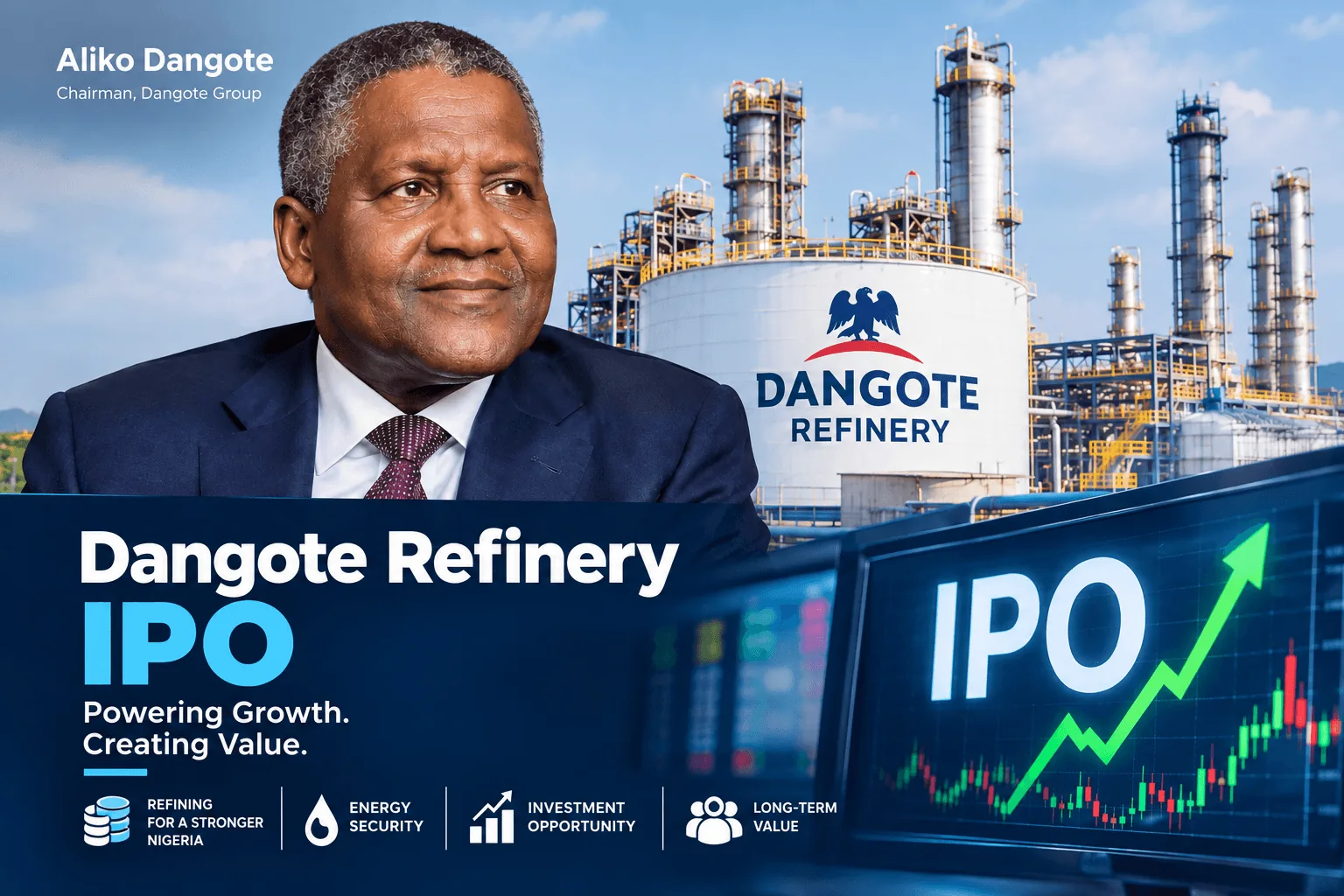
Is ₦525 ($0.40) Really Cheap?#
Imagine Having a round table talk.
Someone asks:
“So, should I buy Dangote Refinery shares?”
One person says:
“Of course. It’s Dangote!”
Another says:
“It’s the biggest refinery in Africa.”
Someone else says:
“₦525 ($0.40) is cheap. I’m buying.”
And then the person who has actually read the prospectus quietly asks:
“Cheap compared with what?”
That question changes the entire conversation.
Because the Dangote Petroleum Refinery IPO is not simply a story about a ₦525 ($0.40) share.
It is a story about a company that could enter the Nigerian Exchange at an indicative equity value of approximately:
₦65.22 trillion — about $47.6 billion#
That is the number investors need to understand.
The IPO is offering 4.1 billion new ordinary shares at ₦525 ($0.40) each, with a minimum subscription of 10 shares, or ₦5,250 ($4). The offer opened on 14 September 2026 and is scheduled to close on 13 October 2026.
So yes, an ordinary Nigerian can potentially participate with ₦5,250 ($4).
But the investment question is much bigger:
Is a roughly $47.6 billion valuation justified by the refinery’s sustainable future earnings and cash flows?
That is what this article is about.
First: What Are You Actually Buying?#
You are not buying “Dangote.”
You are not buying Dangote Cement.
You are not buying the entire Dangote Group.
You are buying shares in:
Dangote Petroleum Refinery and Petrochemicals FZE.
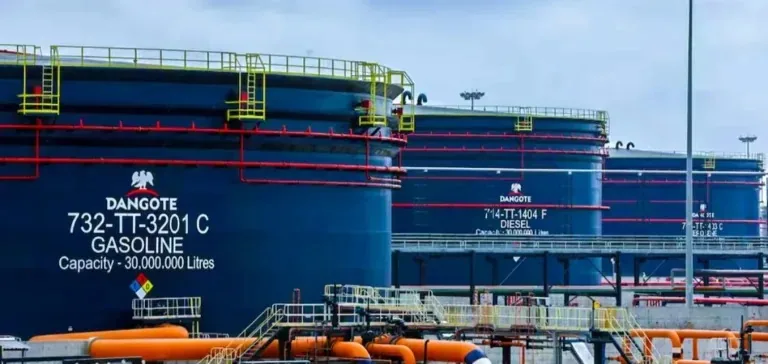
The company operates the enormous integrated refinery and petrochemical complex in Lagos.
The IPO involves 4.1 billion new shares, while the company already has approximately 120.13 billion issued shares.
If the base offer is fully allotted, the post-offer share count is approximately 124.23 billion shares.
At ₦525 per share:
124.23 billion × ₦525 ≈ ₦65.22 trillion.
That is the implied equity value at the offer price.
And this is the first major investment lesson:
Never analyse a stock by looking at the share price alone.#
₦525 can be cheap.
₦525 can be expensive.
₦525 can even be absurdly expensive.
The answer depends on how much economic value the company can generate.
The Business Behind the Share#
Dangote Refinery was built at a reported cost of around $20 billion.
The refinery has capacity of approximately 700,000 barrels per day and has become a major supplier of refined petroleum products to Nigeria and regional markets.
The business has also entered petrochemicals, creating a broader value chain rather than relying exclusively on conventional fuel refining.
The company’s own investor-relations material describes its investment case around scale, integration, strategic location, energy-security relevance and petrochemicals.
But there is something investors should remember:
A giant asset is not automatically a giant investment.
The asset must generate returns.
The Financial Transformation#
This is where the Dangote story becomes genuinely interesting.
The refinery reported a full-year loss of approximately:
$475.8 million in 2025.
Then, during the first half of 2026, it reported:
Revenue: approximately $13.91 billion
Profit after tax: approximately $1.82 billion
That is an extraordinary change.
Reuters reported that the company swung from the 2025 loss to a $1.82 billion after-tax profit in H1 2026.
This is the part of the story that deserves respect.
The refinery moved from an enormous construction project into a much more productive commercial operation.
But now comes the difficult question:
How much of that $1.82 billion is sustainable?
Because there is a massive difference between:
“The company made $1.82 billion in six months.”
and:
“The company can sustainably make $3.64 billion every year.”
The first is historical data.
The second is an assumption.
An investor must never confuse the two.
What Happens If We Annualise H1 2026?#
Purely as a mathematical exercise:
H1 2026 profit after tax:
$1.82 billion
Annualised:
$3.64 billion
Now compare that with the approximate $47.6 billion equity valuation.
That produces an annualised P/E of approximately:
13.1×#
That doesn’t automatically tell us whether the shares are cheap or expensive.
But it gives us a starting point.
And there is an important warning.
Annualising six months of earnings assumes the second half looks broadly like the first half.
That may happen.
It may not.
Refining is cyclical.
Margins move.
Crude prices move.
Product prices move.
Exchange rates move.
Maintenance schedules change.
Global events can alter refining economics.
So the 13.1× figure should be treated as a reference point, not a permanent valuation multiple.
What Are Professional Analysts Expecting?#
This is where things become more interesting.
CardinalStone Research reportedly estimates FY2026 revenue of approximately:
$29.6 billion
and profit after tax of approximately:
$3.8 billion.
Chapel Hill Denham reportedly estimates:
$28.2 billion revenue
and approximately:
$4.1 billion net earnings.
These are analyst forecasts, not company guarantees.
Using the approximate $47.6 billion IPO valuation:
CardinalStone scenario#
$47.6bn ÷ $3.8bn
≈ 12.5× P/E
Chapel Hill scenario#
$47.6bn ÷ $4.1bn
≈ 11.6× P/E
That gives investors something useful.
The IPO is not being priced at a single-digit earnings multiple based on those forecasts.
But neither is it being priced at an extremely high earnings multiple.
The valuation question therefore becomes:
Are $3.8–$4.1 billion annual earnings a reasonable representation of Dangote Refinery’s long-term earning power?
That is the real debate.
Now Let’s Talk About the Analysts Who Think It Is Worth More#
CardinalStone Research reportedly places a 12-month equity valuation of approximately:
₦77.7 trillion
while Chapel Hill Denham estimates approximately:
₦82.62 trillion ($62.53 billion).
Against the IPO’s indicative market capitalisation of approximately:
₦65.22 trillion ($47.6 billion),
both research houses therefore model a higher valuation.
But there is a crucial point here:
An analyst valuation is not a guaranteed future share price.#
It is an estimate based on assumptions.
CardinalStone reportedly uses a combination of:
- discounted cash flow,
- EV/EBITDA,
- price-to-earnings analysis.
Chapel Hill Denham also uses a blended approach involving DCF, EV/EBITDA and P/E.
Their conclusions depend substantially on future earnings, refining margins and the successful expansion of the refinery.
So investors should read these numbers as:
“This is what the business could be worth if these assumptions hold.”
Not:
“The stock must rise to this price.”
Let’s Convert Those Valuations Into Share Prices#
This is where the analysis becomes easier to understand.
Using the approximate post-offer share count of 124.23 billion shares:
IPO valuation#
₦65.22tn ÷ 124.23bn
≈ ₦525 per share
Exactly where the offer starts.
CardinalStone-style valuation#
₦77.7tn ÷ 124.23bn
≈ ₦625 per share
Chapel Hill Denham-style valuation#
₦82.62tn ÷ 124.23bn
≈ ₦665 per share
These calculations are illustrative because analyst models may use different share counts and assumptions.
But they show something important.
The difference between:
₦525
and
₦625–₦665
is not created by magic.
It requires the business to produce the earnings and cash flows assumed in those models.
But Here’s the Number That Should Make Investors Think#
One of the more conservative valuation scenarios cited in the research places equity value at approximately:
₦56.7 trillion.
That is below the IPO’s approximately:
₦65.22 trillion
indicative valuation.
That gives us an extremely useful lesson.
Different assumptions can produce very different valuations.
And therefore:
There is no single mathematically ordained “true value” of Dangote Refinery.
There is a range of possible values depending on how the future unfolds.
The Dangote IPO Bull Case#
Let’s build the optimistic case.
Not a prediction.
A scenario.
Imagine the following happens:
High utilisation#
The refinery operates consistently near capacity.
Strong refining margins#
Global refining economics remain favourable.
Reliable crude supply#
Dangote secures sufficient crude at competitive economics.
Growing exports#
The refinery becomes a major supplier across Africa and potentially beyond.
Petrochemical growth#
Additional downstream products increase margins and diversify revenue.
Expansion succeeds#
The company successfully moves toward approximately:
1.4 million barrels per day.
Debt declines#
Strong operating cash flow reduces leverage.
Capital efficiency remains high#
New investments generate attractive returns.
If those conditions hold, earnings could grow substantially.
And this is why some analysts place valuations well above the IPO price.
The Bear Case#
Now let’s remove the excitement.
Imagine:
Refining margins normalise sharply.
Crude becomes more expensive.
Supply disruptions reduce utilisation.
Expansion costs rise.
Construction takes longer than planned.
Debt remains elevated.
Interest costs increase.
Petrochemical margins weaken.
Global oil demand grows more slowly.
Alternative energy adoption accelerates.
Competition increases.
Regulatory conditions become less favourable.
Suddenly, the earnings assumptions used in bullish valuations become much harder to achieve.
The market then has to reprice the company.
This is why the IPO prospectus itself warns investors that the market price after listing can rise or fall and that investors may lose some or all of their investment.
The Base Case#
The base case is usually much less exciting.
The refinery works.
Production remains strong.
Margins normalise.
The company remains profitable.
Expansion proceeds, but not perfectly.
Debt gradually falls.
Earnings grow, but at a slower pace than the most optimistic forecasts.
In that environment, the market may value the company somewhere between the aggressive and conservative scenarios.
And that is why valuation is ultimately a game of probabilities rather than certainty.
A Simple Scenario Table#
| Scenario | Illustrative earnings environment | What would need to happen |
|---|---|---|
| Bull | Sustained high earnings growth | High utilisation, strong margins, successful expansion, strong petrochemical economics |
| Base | Strong but normalising profitability | Stable operations, normal refining margins, disciplined capex |
| Bear | Lower-than-expected earnings | Margin compression, execution problems, high financing costs, weaker demand |
This is not a prediction of future share prices.
It is a framework for thinking about what must go right — and what could go wrong.
Now We Arrive at the $14.3 Billion Problem#
This is perhaps the most overlooked part of the IPO.
Dangote is not raising money simply because it needs cash to survive.
The IPO is primarily growth capital.
The company intends to expand refining capacity toward approximately:
1.4 million barrels per day#
The full expansion programme is estimated at approximately:
$14.3 billion#
The IPO’s net proceeds are expected to contribute approximately:
₦2.11 trillion ($1.6 billion)
toward that expansion.
That means the IPO does not remotely finance the entire expansion.
It is one part of a much larger capital programme.
According to the reported prospectus allocation:
- approximately ₦841 billion ($638 million) is allocated to utilities, offsites and related infrastructure;
- approximately ₦686.5 billion ($522 million) to refinery process units and major equipment;
- approximately ₦583.5 billion ($444 million) to construction, installation and related expansion works.
The precise dollar conversions vary with exchange rates; the underlying prospectus amounts are the key figures.
Why Expansion Can Create or Destroy Shareholder Value#
This is where serious investing begins.
Suppose you own a company worth $48 billion.
Management says:
“We want to spend another $14.3 billion.”
You don’t clap.
You ask:
“What return will we earn on that $14.3 billion?”
If the expansion generates very strong returns, shareholders benefit.
If it generates mediocre returns, the company may become larger without becoming proportionally more valuable.
If the expansion destroys capital, shareholders can suffer despite impressive production numbers.
That is why:
Revenue growth is not the same thing as value creation.#
The Capacity Trap#
There is a common psychological mistake in industrial investing.
People see:
700,000 barrels/day
and think:
“1.4 million barrels/day will be twice as good.”
Not necessarily.
If the additional 700,000 barrels generate attractive returns, yes.
But if margins decline, capital costs rise and utilisation is poor, doubling capacity could produce much less than double the economic value.
The correct question is:
What is the return on incremental capital?
That is one of the most important questions an investor can ask about Dangote Refinery.
The Debt Question#
At 30 June 2026, reported total indebtedness was approximately:
$5.67 billion#
That was down from approximately:
$6.24 billion
at the end of 2025.
So the company reduced reported debt by roughly:
$570 million
during that period.
That is meaningful.
It suggests the business has begun generating substantial cash and financial capacity.
But $5.67 billion is still a significant amount of debt.
And the expansion programme requires even more capital.
Therefore, investors need to monitor:
Debt / EBITDA
Interest coverage
Free cash flow
Capital expenditure
Debt repayment
Working capital
These numbers may become more important than headline revenue as the company matures.
The $12 Billion EBITDA Ambition#
Reuters reported that Aliko Dangote has envisioned the refinery eventually generating more than:
$12 billion in annual EBITDA#
That is an ambition, not a realised financial result.
And this distinction must be preserved.
If $12 billion of sustainable EBITDA were eventually achieved, a $47.6 billion equity valuation could look very different from today’s perspective.
But investors cannot value the company today as though that future EBITDA is already guaranteed.
The business still has to execute.
The Refining-Margin Trap#
This is where investors without an energy background can get caught.
A refinery doesn’t simply buy crude for $X and sell petrol for $X + profit.
Its economics depend on a complex basket of products and costs.
The value of:
- petrol,
- diesel,
- aviation fuel,
- LPG,
- naphtha,
- petrochemical products,
changes over time.
So does the cost of:
- crude oil,
- shipping,
- storage,
- utilities,
- financing,
- maintenance.
This produces the refining margin.
And refining margins can be extremely cyclical.
That means an investor should never extrapolate one unusually strong period indefinitely.
What Makes Dangote Different?#
The strongest part of the Dangote investment story is arguably not merely refinery size.
It is integration.
The company combines:
crude processing
refined products
petrochemicals
large-scale infrastructure
regional distribution potential.
That creates the possibility of capturing more value across the chain.
The company’s investor-relations materials explicitly identify integration and petrochemical diversification as parts of its strategic investment case.
But integration also creates complexity.
More assets mean:
More capital.
More maintenance.
More operational risk.
More management complexity.
More potential sources of return.
More potential sources of failure.
Nigeria Is Both the Opportunity and the Risk#
Nigeria desperately needs reliable refined petroleum supply.
That creates a major structural opportunity.
But Nigeria also presents challenges.
Foreign exchange volatility.
Infrastructure constraints.
Crude availability.
Pipeline and logistics issues.
Regulatory changes.
Energy-sector reforms.
Consumer purchasing power.
Security.
Interest rates.
All of these can affect the business.
So the same country that provides Dangote Refinery with an enormous addressable market also exposes it to considerable operating risk.
The Export Opportunity#
The refinery isn’t limited to Nigeria.
Africa has historically imported substantial quantities of refined petroleum products.
Dangote’s scale gives it an opportunity to supply regional markets.
The refinery has already exported products, including aviation fuel.
That matters because a large export market can reduce dependence on a single domestic market.
But exports also introduce:
- shipping costs,
- international competition,
- currency considerations,
- geopolitical exposure,
- international product-price cycles.
Again:
opportunity and risk arrive together.
The Retail Investor Advantage#
There is one thing the retail investor can potentially do better than institutions:
think long-term.
An institutional fund may face quarterly performance pressure.
A retail investor can theoretically hold a high-quality business for many years.
But that advantage disappears if the retail investor checks the stock price every ten minutes.
If Dangote shares move from:
₦525 → ₦560 → ₦500 → ₦590 → ₦475
and you panic at every movement, you aren’t investing.
You’re reacting.
A long-term investor should focus on whether the underlying business is becoming more or less valuable.
What Would Make Me Reconsider the Investment Thesis?#
This is a much better question than:
“Will the stock rise?”
Watch for fundamental changes.
Warning sign 1: Falling utilisation#
If the refinery repeatedly operates well below economic capacity, investigate why.
Warning sign 2: Shrinking margins#
If profitability falls because refining economics deteriorate, determine whether it is cyclical or structural.
Warning sign 3: Rising debt#
If debt keeps increasing while cash flow fails to improve, investigate.
Warning sign 4: Expansion cost overruns#
A $14.3 billion project becoming materially more expensive would change the investment equation.
Warning sign 5: Weak cash conversion#
Profit without strong operating cash flow deserves scrutiny.
Warning sign 6: Governance concerns#
Public shareholders need transparency.
Warning sign 7: Poor returns on new capital#
A bigger refinery isn’t automatically a more valuable refinery.
The Governance Question#
This may become increasingly important after listing.
Private companies and public companies live under different levels of scrutiny.
Once public investors own shares, they will reasonably expect:
- timely reporting,
- transparent financial statements,
- strong board oversight,
- clear related-party disclosures,
- disciplined capital allocation,
- appropriate shareholder communication.
The company has established an investor-relations platform focused on governance visibility, disciplined disclosure and operational transparency as it enters the capital markets.
The real test will come through years of public reporting.
The FOMO Test#
Here’s a simple exercise.
Imagine the Dangote IPO disappeared from social media tomorrow.
No influencers.
No TikTok videos.
No WhatsApp messages.
No memes.
No celebrity commentary.
No “₦525 to ₦1,000 soon” posts.
Would you still understand:
what the company does?
how it makes money?
what it is worth?
what could go wrong?
why you own it?
If the answer is no, you probably haven’t finished your research.
The ₦5,250 ($4) Trap#
The minimum subscription is only:
₦5,250 ($4).
That is intentionally accessible.
But accessibility can create a psychological illusion.
Someone may think:
“It’s only four dollars. What’s the risk?”
But if you buy:
1,000 shares:
₦525,000 ($400)
10,000 shares:
₦5.25 million ($4,000)
100,000 shares:
₦52.5 million ($40,000)
Suddenly the investment becomes much more significant.
The percentage risk doesn’t change because the ticket size changes.
Your potential gain and potential loss scale with the amount invested.
A Simple Return Framework#
Suppose, purely as an illustration, an investor buys:
10,000 shares at ₦525.
Cost:
₦5.25 million ($4,000)
If the shares later trade at ₦700:
Value:
₦7 million ($5,333)
Ignoring fees, taxes and currency movements, the investor’s capital gain would be:
₦1.75 million ($1,333)
But if the shares trade at ₦400:
Value:
₦4 million ($3,048)
Loss:
₦1.25 million ($952)
The point is not that either price will happen.
The point is:
The IPO price is not a guaranteed floor.#
Once listed, market forces determine the trading price.
What About Dividends?#
This is another area where investors should remain disciplined.
Dividends are not guaranteed.
The company has enormous expansion requirements.
Management must balance:
- dividends,
- debt reduction,
- working capital,
- maintenance,
- expansion,
- liquidity.
Therefore, nobody should build a Dangote investment thesis around a dividend that hasn’t been declared.
The share can generate returns through:
dividends
and/or
capital appreciation.
But neither should be assumed without evidence.
The Real Valuation Framework#
If I were building an institutional-style investment dashboard for Dangote Refinery, I would track five valuation lenses.
Lens 1: P/E#
How much are investors paying for each dollar of sustainable earnings?
Lens 2: EV/EBITDA#
This becomes particularly useful because Dangote has significant debt and a massive asset base.
It allows comparison of enterprise value against operating earnings.
Lens 3: DCF#
What is the present value of future free cash flows?
This is particularly important for a capital-intensive company.
Lens 4: Replacement / asset value#
What would it cost to recreate an equivalent industrial asset?
This matters for understanding the strategic value of the physical infrastructure.
Lens 5: Return on invested capital#
This may be the most important long-term metric.
The refinery required enormous capital.
Investors need to know whether that capital is producing an attractive return.
What the Valuation Range Is Really Telling Us#
Put everything together.
IPO valuation#
Approximately:
₦65.22 trillion ($47.6 billion)
CardinalStone valuation#
Approximately:
₦77.7 trillion ($58.8 billion)
Chapel Hill Denham valuation#
Approximately:
₦82.62 trillion ($62.5 billion)
More conservative valuation scenario reported in the research#
Approximately:
₦56.7 trillion ($43 billion-plus)
The lesson isn’t:
“Dangote is worth ₦82 trillion.”
Nor is it:
“Dangote is worth only ₦56 trillion.”
The lesson is:
Small changes in assumptions can produce tens of trillions of naira in valuation differences.#
That is exactly what happens with large, capital-intensive, cyclical businesses.
The Five Numbers I Would Watch Every Quarter#
If you’re a long-term shareholder, don’t obsess over the daily stock price.
Watch these:
1. Utilisation rate#
Is the refinery actually running efficiently?
2. EBITDA margin#
Is operating profitability strengthening or weakening?
3. Free cash flow#
Is accounting profit translating into cash?
4. Net debt#
Is leverage falling or rising?
5. ROIC#
Is management generating attractive returns on the enormous capital invested?
These five numbers tell you much more about the business than Twitter sentiment.
The Most Important Question of All#
Here is the question I would put at the top of every investor’s notebook:
If Dangote Refinery never became bigger than it is today, would the existing business still justify the valuation?
That is an excellent stress test.
Because if the investment only makes sense if:
1.4 million barrels/day happens
$12 billion EBITDA happens
high refining margins continue
exports grow rapidly
petrochemicals perform strongly
then the investment depends on a lot of future events.
But if the existing 700,000-barrel-per-day operation can independently generate strong, sustainable free cash flow, the expansion becomes upside rather than the entire foundation of the thesis.
That is a much stronger position.
BrandKabal’s Investor Scorecard#
Rather than giving the IPO a simplistic “buy” or “don’t buy” rating, here’s the framework investors can use.
| Question | Evidence to examine |
|---|---|
| Is the business strategically important? | Refining capacity, domestic demand, regional exports |
| Is it profitable? | H1 2026 earnings and future audited results |
| Is profitability sustainable? | Refining margins across multiple periods |
| Is leverage manageable? | Debt, interest costs and free cash flow |
| Is growth attractive? | Returns from the $14.3bn expansion |
| Is the IPO valuation reasonable? | P/E, EV/EBITDA, DCF and peer comparisons |
| Is management allocating capital well? | ROIC and expansion economics |
| Is governance strong? | Public reporting and shareholder protections |
| What can destroy the thesis? | Margins, crude supply, debt, execution and regulation |
| Does it fit the investor? | Time horizon, risk capacity and diversification |
This is the type of framework that turns an IPO from a social-media event into an investment analysis.
So, What Is the Honest Answer?#
The honest answer is not:
“Dangote IPO will make you rich.”
And it is not:
“Dangote IPO is overpriced.”
The evidence doesn’t justify such certainty.
What the evidence does show is that the company has undergone a remarkable operational transformation, moving from a major construction project and reported losses into substantial profitability in H1 2026. Analysts have also published valuations above the IPO’s indicative market capitalisation, although their conclusions depend heavily on assumptions around future earnings, refining margins and expansion.
At the same time, the business carries significant capital requirements, substantial debt, commodity-cycle exposure and execution risk.
So the real investor question is:
Can Dangote Refinery turn its enormous scale into sustainable returns on capital over many years?
Nobody knows that with certainty today.
The next few years of financial reporting will provide the evidence.
BrandKabal’s Final Take#
The Dangote IPO may ultimately become one of the most important events in Nigeria’s modern capital-market history.
But its importance isn’t simply that Nigerians can buy shares for ₦525 ($0.40).
Its importance is that Nigeria is being given another opportunity to move from:
consumption
to
ownership.
That is powerful.
But ownership comes with responsibility.
If you buy because everyone else is buying, you are following a crowd.
If you buy because you understand the business, understand the valuation, understand the risks and accept the possibility of losing money, you are behaving more like an investor.
And that distinction will matter enormously.
Because Dangote Refinery is not a small startup.
It is a gigantic industrial machine sitting at the intersection of:
oil
gas
petrochemicals
infrastructure
foreign exchange
African trade
energy security
capital markets
and
industrialisation.
At the IPO price, the market is effectively asking investors to value that machine at approximately:
₦65.22 trillion ($47.6 billion).#
The bullish analysts see a path toward substantially higher values.
The more conservative scenarios demonstrate that downside is also possible.
Neither side can know the future.
What investors can know is the price they are paying.
They can study the cash flows.
They can study the debt.
They can study the margins.
They can study the expansion.
They can study the risks.
And then they can make their own decision.
That is what investing is supposed to be.
Not:
“Dangote said it, so buy.”
Not:
“Everybody is buying, so buy.”
Not:
“It’s only ₦525 ($0.40), so what can go wrong?”
But:
“I understand what I’m buying, what I’m paying, what could go right, what could go wrong and why I am willing to own it.”
That is the honest conversation.
And perhaps that is the biggest lesson the Dangote IPO can teach an entire generation of Nigerian investors.
BrandKabal’s 10 Rules for Anyone Studying the Dangote IPO#
1. Never confuse ₦525 ($0.40) with cheap. Study the ₦65.22 trillion ($47.6 billion) company valuation.
2. Don’t annualise one good half-year blindly. H1 2026 was exceptional. The next question is sustainability.
3. Watch refining margins. They can have enormous influence on earnings.
4. Watch free cash flow. Profit isn’t the same thing as cash.
5. Watch debt. A $5.67 billion debt balance deserves attention.
6. Treat the $14.3 billion expansion as an investment decision. Ask what return the additional capital will produce.
7. Don’t blindly copy analyst valuations. Understand their assumptions.
8. Don’t invest because of the founder’s reputation. Analyse the company you are actually buying.
9. Ignore FOMO. The market will still exist after the hype disappears.
10. Read the prospectus. The prospectus contains the actual risks, terms and financial information. The SEC specifically advises prospective investors to read the approved prospectus and use only authorised channels.
One Last Thought#
Perhaps the most important thing about the Dangote IPO isn’t whether the share price eventually reaches ₦700, ₦1,000 or something else.
The bigger story is what happens when Nigerians begin to see themselves differently.
Not only as customers.
Not only as employees.
Not only as consumers of the products created by giant corporations.
But as owners of productive businesses.
That is the promise of a functioning capital market.
But ownership without knowledge can become speculation.
Ownership with knowledge becomes investing.
So before you ask:
“How much can I make?”
Ask:
“What exactly am I buying?”
Before you ask:
“Will Dangote go up?”
Ask:
“What is Dangote Refinery worth under realistic assumptions?”
And before you ask:
“Should I buy?”
Ask the question that serious investors have been asking for centuries:
“What am I paying for the value I am receiving?”#
That is where the real investment story begins.
Sources & Editorial Note#
This analysis uses the official Dangote Petroleum Refinery IPO information, the Nigerian Securities and Exchange Commission, Reuters reporting and published Nigerian investment-research analysis. The official IPO site confirms the 4.1 billion-share offer at ₦525 ($0.40), 10-share minimum subscription, and 14 September–13 October 2026 offer period.
The approximately ₦65.22 trillion ($47.6 billion) indicative equity valuation is derived from the IPO price and post-offer share count reported in prospectus-related coverage.
H1 2026 revenue and profit figures, including approximately $13.91 billion revenue and $1.82 billion profit after tax, are reported financial figures rather than forecasts. Reuters reported the comparison with the approximately $475.8 million loss for FY2025.
The $3.8 billion CardinalStone and $4.1 billion Chapel Hill Denham FY2026 earnings figures, as well as their respective valuation estimates, are analyst estimates and should not be treated as guaranteed outcomes.
The approximately $14.3 billion expansion programme and target capacity of approximately 1.4 million barrels per day are based on prospectus-related reporting. The IPO proceeds constitute only part of the capital required for the expansion.
The article’s bull, base and bear frameworks are analytical scenarios rather than predictions of future share prices.
Investment disclaimer: This article is educational and does not constitute personalised investment advice, an offer to buy securities or a recommendation to subscribe to the Dangote IPO. Investing involves the risk of losing capital. Prospective investors should read the approved prospectus and, where appropriate, consult a SEC-registered investment adviser, stockbroker or other qualified professional. The SEC has specifically warned investors to use only approved subscription channels and to avoid unsolicited offers or guaranteed-allotment schemes.



Join the conversation