
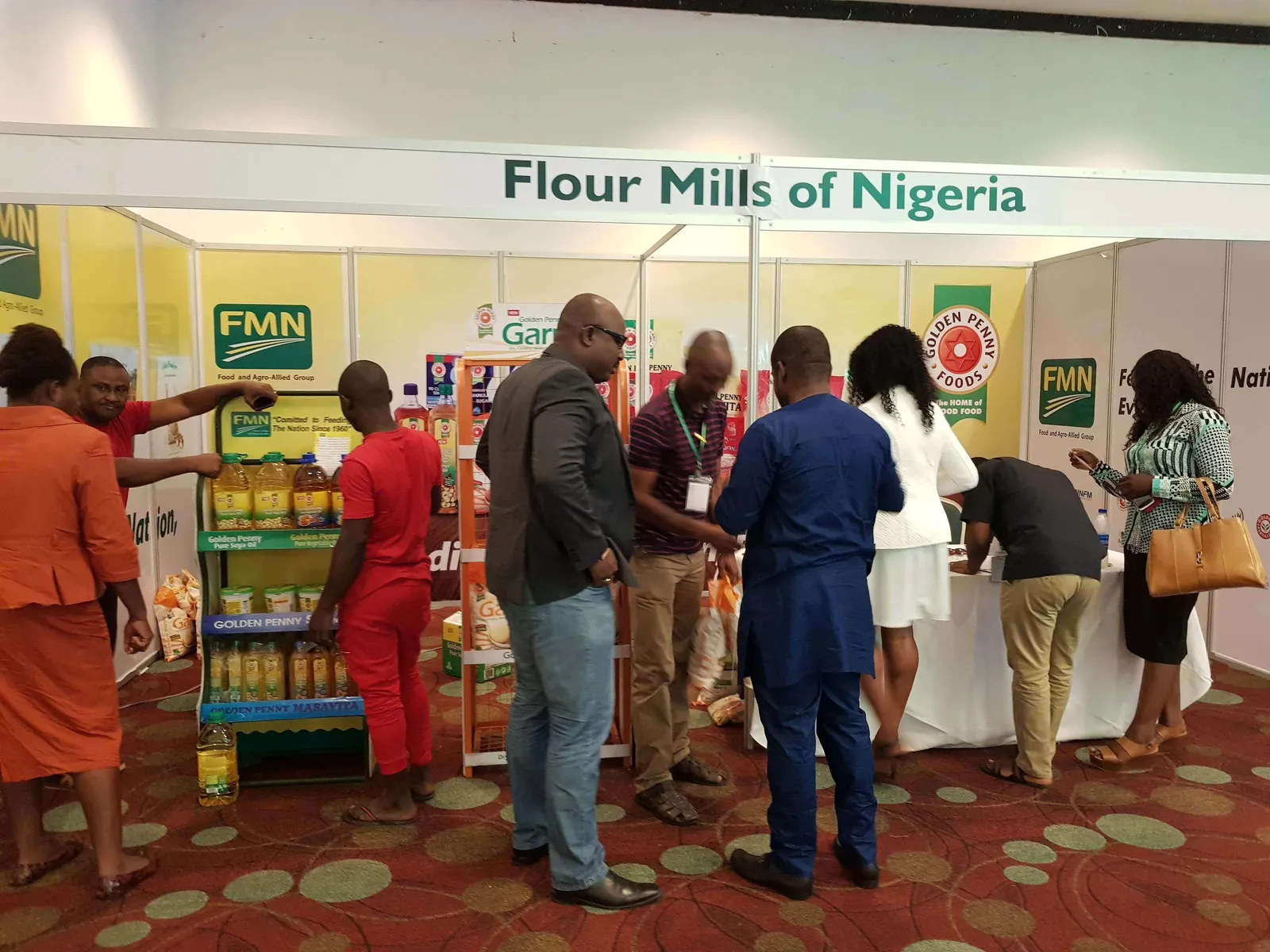
# The Brand Behind Your Bread, Pasta and Semovita: How Flour Mills of Nigeria Turned One Apapa Mill into a Food Empire
The remarkable story of a Nigerian business that moved beyond flour milling to build one of the country's most recognisable food and agro-allied groups — and the lessons its journey holds for African entrepreneurs.
Picture a typical Saturday morning in Nigeria.
A baker is already at work, preparing dough for the day's bread. Somewhere else, a mother is making breakfast for her children. A student is preparing a quick plate of noodles. A family is getting ready for lunch, with semovita on the menu.
Different homes. Different meals. Different budgets.
But behind some of these everyday experiences are familiar names: Golden Penny Flour, Golden Penny Pasta, Golden Penny Noodles, Semovita, sugar and cooking oil.
For many Nigerians, these are simply products on a supermarket shelf or ingredients in the kitchen. We rarely stop to think about the business behind them: the factories, farmers, warehouses, supply chains, machinery, distribution networks and commercial decisions required to keep food moving from production facilities to millions of consumers.
That is where the story of Flour Mills of Nigeria (FMN) becomes interesting.
What began as a pioneering flour-milling business has evolved into a diversified food and agro-allied group with activities spanning food processing, agriculture, sugar, logistics and other supporting operations.
Its journey is not just about selling flour. It is about understanding an essential truth about business:
When you control more of the journey between raw materials and the final customer, you have an opportunity to build a business that is much bigger than its original product.
And FMN's evolution offers an important lesson in how African businesses can build enduring brands by solving everyday problems at scale.
From an ambitious idea to an industrial landmark#
The story began with an entrepreneur named George S. Coumantaros.
On September 29, 1960, Flour Mills of Nigeria was incorporated. The business commenced flour-milling operations in 1962, becoming one of Nigeria's pioneering industrial flour millers.
At a time when Nigeria was approaching independence and its economy was still developing, the idea of establishing a major local milling operation was significant. Rather than simply depending on finished imported products, the company set out to process wheat and supply flour to Nigerian businesses and households.
Its initial milling capacity was approximately 500 metric tonnes per day.
That figure is worth remembering.
According to FMN's 2023 sustainability report, the group's daily grinding capacity had grown to approximately 9,310 metric tonnes — a remarkable increase from its early operating scale.
It is a difference of roughly 18.6 times its original daily capacity.
The business had moved well beyond the limitations of a single industrial mill.
And that was only the beginning.
Over the decades, FMN expanded its product range, manufacturing facilities, agricultural activities and supporting operations. Its purpose, expressed through the phrase "Feeding the Nation, Everyday," became closely associated with the role it wanted to play in Nigeria's food economy.
There is an important distinction here: FMN was incorporated in 1960, but its milling operations began in 1962. Both dates matter when understanding its history.
The business behind the products#
One of the easiest ways to underestimate FMN is to think of it as a company that makes flour.
It is much more than that.
The group has historically organised its activities around four broad value chains: Food, Sugar, Agro-Allied and Support Services.
Each plays a different role in the wider business.
1. Food: The strength of Golden Penny#
The most visible part of FMN's business is its food portfolio.
Its flagship consumer brand, Golden Penny, is built around products that serve different household and commercial needs.
The range includes:
- Flour for household baking, bakeries and confectioners.
- Pasta products such as spaghetti, macaroni and other pasta varieties.
- Instant noodles.
- Semovita and other grain-based food products.
- Garri and other traditional food options.
- Granulated sugar and sugar cubes.
- Vegetable oils, soya oil, spreads and related products.
- Breakfast products.
This breadth is strategically important.
A company that sells only one product must continually defend that product's market position. A company with a relevant portfolio can build relationships with customers across several purchasing occasions.
A household may buy flour for baking, pasta for lunch, noodles for a quick meal, sugar for beverages and cooking oil for dinner.
The products serve different needs, but the brand can create a familiar point of recognition.
That is the commercial advantage of a well-managed brand portfolio.
Golden Penny is not simply a name printed on packaging. It is an attempt to create familiarity, recognition and consumer confidence across several food categories.
2. Sugar: Building beyond the refinery#
Sugar is another important part of the group's food strategy.
FMN's Golden Sugar business includes refining and the development of local sugar production through agricultural investments.
One notable project is Sunti Golden Sugar Estates in Niger State, located close to the River Niger.
The estate is part of the group's backward-integration ambition: moving further upstream into agricultural production rather than depending entirely on imported raw materials.
FMN's sustainability reporting has described substantial investment in farmland, irrigation and sugarcane-processing infrastructure at Sunti.
Why is this important?
Because sugar is not simply a packaged product.
It begins with land, water, agricultural inputs, farmers, harvesting, transportation, processing and refining. Each stage affects the cost and reliability of the final product.
The company therefore has a strategic reason to participate in more than the refining stage.
The wider Nigerian sugar industry also has a long-standing challenge: increasing local production and reducing dependence on imported sugar and raw materials.
FMN's investment in sugarcane cultivation is part of that bigger economic conversation.
3. Agro-allied: The business behind the food business#
This is perhaps one of the most strategically important parts of FMN's story.
Food manufacturing depends on agriculture.
Flour requires wheat. Livestock feeds require ingredients such as maize and soybean. Edible oils require oilseeds and other agricultural inputs. Sugar depends on sugarcane or imported raw materials.
A manufacturer that ignores the agricultural side of its business can become heavily exposed to supply shortages, price fluctuations and foreign-exchange pressure.
FMN has therefore invested in several agro-allied activities, including farming, livestock feeds, edible oils, agricultural inputs and other forms of agricultural processing.
Its agro activities include value chains around crops such as maize, soybean, cassava and oil palm.
The group's stated ambition is to increase the use of locally sourced raw materials and build stronger connections between farmers and its manufacturing operations.
On its FMN Agro platform, the company says it has invested more than ₦150 billion ($111.4 million) over ten years in agriculture and infrastructure to support its backward-integration strategy.
That figure is a company-reported cumulative investment, not a claim that all its raw materials are now locally sourced.
The distinction matters.
A company's ambition to source locally is not the same as having already achieved complete local sourcing.
Still, the strategy points in an important direction: the future of food manufacturing in Nigeria cannot be separated from the future of Nigerian agriculture.
4. Support services: The infrastructure most consumers never see#
There is another side of FMN that customers may rarely think about.
Food has to be moved, stored, packaged and distributed before it reaches the consumer.
These activities are expensive, complex and essential.
FMN's historical support-services operations have included logistics, transport, shipping, port-related activities, warehousing and packaging-related businesses.
The group has also operated bulk terminals at Apapa Port, giving it a role in the movement and handling of commodities.
Its packaging business, BAGCO, was restructured in 2024 to operate as a separate entity under the name BAGCO Industrial Solutions Limited. This is an example of how the group's corporate structure has evolved over time.
The bigger lesson is that manufacturing is not just about producing something.
It is also about ensuring that the product can reach the right customer, in the right condition, at the right time and at a cost that makes commercial sense.
Golden Penny: How an ordinary product becomes a powerful brand#
Let's look at the branding side of the business.
There is a reason Golden Penny deserves attention beyond its product categories.
The company has built a recognisable brand around a basic but powerful proposition: food products for everyday consumption.
This is an interesting brand strategy because it does not depend entirely on luxury, aspiration or exclusivity.
It competes in categories where consumers frequently make practical decisions based on price, availability, quality, convenience and familiarity.
In those markets, trust matters.
A baker needs flour that performs consistently. A household wants a familiar product. A retailer wants products that customers recognise and request.
A brand that can build confidence across these different customer groups has an opportunity to become part of the purchasing routine.
That is a very different kind of brand equity from simply having an attractive logo.
A logo helps people recognise a business.
A strong brand gives them a reason to remember, choose and return to it.
FMN's portfolio also shows why brand architecture matters.
Golden Penny operates as a recognisable umbrella across several food products. Individual product categories can address different customer needs while benefiting from the familiarity of the parent brand.
But the strategy has another dimension: FMN has not relied exclusively on Golden Penny.
The Honeywell acquisition: A major move in the food industry#
In 2021, Flour Mills of Nigeria and Honeywell Group announced an agreement to combine FMN's business with Honeywell Flour Mills.
The transaction was completed in April 2022 after the relevant regulatory approvals.
FMN acquired Honeywell Group's 71.69% stake in Honeywell Flour Mills. It also acquired an additional 5.06% minority shareholding from First Bank of Nigeria.
Why was this significant?
Because Honeywell Flour Mills already had established operations and recognised products in Nigeria's food market, including flour, pasta, noodles and semolina-related products.
The combination brought together two established businesses with complementary brands, manufacturing capabilities and distribution reach.
Strategically, acquisitions can achieve things that organic expansion may take years to deliver.
They can provide access to:
- Existing customer relationships.
- Established product brands.
- Manufacturing capacity.
- Distribution networks.
- Skilled employees.
- Supplier relationships.
- New opportunities for operational efficiency.
But acquisitions are not automatically successful.
The real value comes after the transaction.
Management must integrate operations, manage costs, retain customer confidence, avoid unnecessary duplication and ensure that the combined business is more efficient than the separate companies were.
FMN's challenge is therefore not merely to own more brands and factories.
It is to turn that enlarged footprint into stronger operating performance.
The big opportunity: Nigeria's food market is enormous#
To understand why FMN's strategy matters, look at Nigeria's wheat industry.
Bread, pasta, noodles, pastries and other wheat-based foods are part of everyday consumption for millions of Nigerians.
But Nigeria still depends heavily on imported wheat.
The United States Department of Agriculture's Foreign Agricultural Service, in its March 2026 Nigeria Grain and Feed Annual report, projected that Nigeria would import approximately 7.2 million metric tonnes of wheat in the 2026/27 marketing year.
The same report estimated domestic wheat production at approximately 140,000 metric tonnes, while consumption was projected at 6.8 million metric tonnes.
This is a striking gap.
It highlights one of the structural challenges facing Nigeria's food manufacturers: a large consumer market exists, but domestic agricultural production has not yet expanded enough to meet the country's wheat requirements.
For a major flour miller, this creates both an opportunity and a risk.
The opportunity is obvious.
A business with manufacturing capacity, supplier relationships, agricultural expertise and distribution infrastructure can participate in a large and recurring food market.
The risk is equally important.
When a major raw material is imported, the manufacturer becomes exposed to international commodity prices, shipping costs, foreign-exchange availability and currency movements.
Even when consumer demand remains strong, input costs can put pressure on margins.
This is why backward integration is more than a corporate slogan.
It is a strategic response to a real supply-chain vulnerability.
From farmers to factories: Making local sourcing work#
A particularly encouraging development is the growing emphasis on partnerships between food manufacturers, financial institutions, government agencies and farmers.
In Cross River State, Project Grow has worked with Flour Mills of Nigeria on agricultural training and market access.
A state government report in 2026 stated that the programme had supported the cultivation of approximately 450 hectares of maize and soybean farms during the 2025 farming season.
It also reported an offtake agreement with Flour Mills of Nigeria for 2,000 metric tonnes of soybean and 20,000 metric tonnes of maize, with an estimated value of ₦18 billion ($13.4 million).
This kind of arrangement is important because farmers do not only need seeds, fertiliser and training.
They also need a dependable market for what they produce.
An offtake agreement can help connect production to a buyer, giving agricultural enterprises a clearer commercial pathway.
For a manufacturer, it can help strengthen supply relationships and improve visibility over raw-material sourcing.
For farmers, it can create a more organised route to market.
For Nigeria, it can contribute to a stronger domestic food-production system.
That is the promise of a properly designed agricultural value chain.
It is not enough to encourage people to farm. The system must connect farmers to inputs, finance, technology, storage, processing and buyers.
The numbers: Is a large business automatically a profitable business?#
Now let's move from the inspirational side to the financial reality.
A serious business story must look beyond brand recognition and revenue.
For the financial analysis below, the audited full-year results used are for the financial year ended March 31, 2024. They are historical figures, not a representation of FMN's current 2026 performance.
The figures are converted using an approximate exchange rate of ₦1,346.26 to $1, based on the Central Bank of Nigeria's NFEM reference rate published for October 30, 2026. This is a common conversion reference for the article, not the exchange rate that applied when the historical accounts were prepared.
FMN's FY2024 financial performance#
| Financial measure | Reported figure | Approximate USD equivalent |
|---|---|---|
| Revenue | ₦2.29 trillion | $1.70 billion |
| Gross profit | ₦272.75 billion | $202.6 million |
| Operating profit | ₦208.13 billion | $154.6 million |
| Loss before tax | ₦236.69 million | $176,000 |
| Profit after tax | ₦3.54 billion | $2.63 million |
The numbers tell an interesting story.
Revenue increased by approximately 49% compared with the previous financial year.
Operating profit also increased.
Yet profit after tax fell by approximately 88%, from about ₦29.5 billion ($21.9 million) in FY2023 to approximately ₦3.54 billion ($2.63 million) in FY2024.
What happened?
The company faced substantial financial pressure, including foreign-exchange losses, higher costs and financing-related expenses.
The audited report recorded a loss before tax of approximately ₦236.69 million ($176,000). The final reported profit after tax was supported by an income-tax credit of approximately ₦3.78 billion ($2.81 million).
This is an important detail.
It means the reported profit should not be interpreted as evidence that the company had enjoyed a particularly strong underlying year.
The lesson is straightforward:
Revenue growth is not the same thing as profit growth.
A business can sell more products, generate more turnover and still struggle to retain enough earnings after paying for raw materials, power, transportation, financing and other expenses.
A later interim result showed a recovery#
For additional context, FMN's unaudited results for the six months ended September 30, 2024, reported:
- Revenue of approximately ₦1.70 trillion ($1.26 billion).
- Profit before tax of approximately ₦19.75 billion ($14.7 million).
- Profit after tax of approximately ₦14.42 billion ($10.7 million).
This represented a significant improvement compared with the corresponding half-year period in the previous financial year.
But it is important to read the figures correctly: these are interim results for the first half of FY2024/25, not the company's full-year 2025 or 2026 results.
A business analyst should never use an interim result as though it were an audited annual result.
And a strong recovery in one reporting period does not automatically guarantee that every future period will be equally strong.
A major corporate development: FMN left the Nigerian Exchange#
There is another development that investors and business observers should understand.
FMN was historically listed on the Nigerian Stock Exchange, later known as Nigerian Exchange Limited.
However, following a scheme of arrangement involving its majority shareholder, Excelsior Shipping Company Limited, and its subsidiary Greywise Investment Solutions Limited, the company's entire issued share capital was delisted from the NGX on December 30, 2024.
The scheme was approved by shareholders, and minority shareholders were compensated under the arrangement.
Why does this matter?
Because Flour Mills of Nigeria is no longer a company whose shares can be bought and sold through the NGX's daily official equity list.
For a company that spent decades as a publicly listed Nigerian business, this was a significant corporate transition.
It also means that ordinary investors and researchers may find it more difficult to access the kind of continuous public-market disclosures, trading information and market valuation data that were previously available.
The company's operational story continues, but its relationship with the public capital market has changed.
This is worth remembering whenever someone discusses FMN as a publicly traded stock.
The real challenges facing Flour Mills of Nigeria#
It would be easy to turn this story into a celebration of corporate expansion.
But every serious business has to confront its weaknesses and risks.
FMN faces several challenges that could shape its next decade.
1. Dependence on imported wheat#
The gap between Nigeria's projected wheat imports and local production is a major structural challenge.
Imported wheat exposes millers to international prices, freight costs, currency availability and geopolitical disruptions.
Local wheat production must become more productive and better aligned with the quality requirements of industrial milling if it is to reduce this vulnerability meaningfully.
2. The cost of doing business#
Food manufacturing is capital-intensive.
Factories require reliable electricity, equipment maintenance, transportation, skilled labour, packaging materials and working capital.
When these costs rise faster than selling prices, margins become weaker.
A manufacturer cannot always pass every increase to consumers without risking lower demand.
3. Consumer affordability#
Nigeria is a price-sensitive market.
A household experiencing pressure on its income may reduce spending, switch brands, buy smaller quantities or choose cheaper alternatives.
For a consumer-food business, this creates a constant balancing act between affordability, product quality and profitability.
4. Competition#
FMN does not operate in an empty market.
Nigeria's food and flour-milling industries include other significant businesses, including BUA and Olam-linked operations.
The USDA has described Nigeria's flour-milling sector as highly concentrated, with FMN, Olam and BUA collectively accounting for a large share of industry capacity.
That makes efficiency, customer loyalty, product innovation and distribution even more important.
5. Integrating a larger business#
The Honeywell acquisition increased FMN's reach and expanded its portfolio.
But the real test is whether the combined operations can deliver better efficiency and sustainable earnings.
A larger organisation can create economies of scale.
It can also become more complicated to manage.
The difference comes down to execution.
What African entrepreneurs can learn from FMN#
The most valuable part of this story is not the number of products in FMN's portfolio.
It is the thinking behind the company's evolution.
There are several lessons every ambitious African business can study.
1. Start with a real problem#
FMN's origins were connected to a practical need: processing wheat and supplying food products to a growing Nigerian market.
A business built around a real, recurring need has a meaningful foundation.
Entrepreneurs should ask themselves:
What problem do people face regularly enough to pay for a solution?
The stronger the need, the more opportunities may exist to build a sustainable business around it.
2. Do not remain trapped by your first product#
FMN began with flour milling.
Over time, it developed a broader food and agro-allied portfolio.
That does not mean every business should diversify into unrelated industries.
It means successful companies should continually examine adjacent opportunities that strengthen their core business.
The best expansion often happens where customers, capabilities, suppliers and distribution networks already overlap.
3. Build the value chain, not just the product#
One of FMN's clearest strategic lessons is the importance of participating in more stages of the value chain.
Manufacturers that understand sourcing, processing, packaging, logistics and distribution can identify inefficiencies that a business focused only on the final product may miss.
This is particularly important in Africa, where supply-chain weaknesses can make otherwise attractive business opportunities expensive and unreliable.
4. Understand the power of brand architecture#
Golden Penny demonstrates the value of creating a recognisable brand across different product categories.
A company does not need to build a completely new identity every time it launches an adjacent product.
With a clear brand architecture, the parent brand can help establish familiarity while individual products communicate their specific benefits.
However, every product must still deliver on its promise.
Brand recognition can encourage a first purchase; consistent quality is what gives customers a reason to return.
5. Invest in your supply chain before it becomes a crisis#
FMN's agricultural investments reflect a broader business reality.
Dependence on external suppliers can become dangerous when markets change, currencies weaken or raw materials become scarce.
Where it makes commercial sense, businesses should develop stronger local supplier relationships, support productivity and improve supply visibility.
For African manufacturers, this can become a competitive advantage.
6. Acquire businesses for strategic reasons, not excitement#
The Honeywell transaction demonstrates how acquisitions can expand a company's capabilities and market reach.
But acquiring a business is only the beginning.
The real value is created through integration, efficiency, innovation and the ability to deliver better outcomes after the deal.
Entrepreneurs should never confuse the size of an acquisition with the quality of its execution.
7. Protect your margins#
The FY2024 financial results provide a clear reminder that high turnover does not automatically create strong profits.
Businesses must monitor their costs, cash flow, working capital, financing structure and operating efficiency.
A company can be popular and still be financially vulnerable.
The objective should not only be to sell more.
It should be to build a business that retains enough value from every sale to fund its future.
8. Think in generations#
FMN's history stretches across more than six decades.
Its evolution illustrates the importance of building systems, capabilities and relationships that can survive beyond one product cycle or one generation of customers.
A business that wants to become an institution must think beyond immediate sales.
It must build processes, leadership capacity, talent, governance and a culture that can endure.
BrandKabal's Final Take#
Flour Mills of Nigeria is an important business story because it demonstrates how an African company can evolve from a specialised manufacturing operation into a diversified player in an essential industry.
Its journey began with flour milling.
It expanded into pasta, noodles, semovita, edible oils and sugar.
It invested in agricultural activities, manufacturing infrastructure and supporting operations.
It acquired a major stake in Honeywell Flour Mills, strengthening its position in Nigeria's food market.
It has also pursued partnerships that connect local farmers to agricultural inputs, processing businesses and commercial buyers.
But the story is not without its challenges.
The company's FY2024 financial results showed how foreign-exchange exposure and operating costs can weaken the relationship between impressive revenue growth and actual profitability. Nigeria's dependence on imported wheat also illustrates the structural difficulties facing the wider food manufacturing industry.
That is why the next chapter of FMN's story should not be judged by the number of products it introduces or the size of its manufacturing footprint alone.
It should be judged by how efficiently it operates, how much more resilient its supply chain becomes, how successfully it supports local agriculture, how consistently it earns consumer trust and how much value it creates from its investments.
For African entrepreneurs, perhaps the most powerful lesson is this:
Do not build a business that only sells a product. Build a business that understands the entire system required to create, deliver and sustain that product.
A flour mill can become a food company.
A food company can become an agro-industrial group.
And a familiar brand can become part of the everyday lives of millions of people.
That is the larger story behind Flour Mills of Nigeria.
It is not simply about flour.
It is about the business of feeding a nation.
BrandKabal's 10 Big Lessons from Flour Mills of Nigeria#
1. Build around everyday needs. Businesses that solve recurring problems have opportunities to create long-term customer relationships.
2. Think beyond your first product. Expansion into related categories can create new revenue opportunities and strengthen the core business.
3. Build a recognisable brand. Familiarity, consistent quality and availability can turn a product into a household choice.
4. Invest in the value chain. Sourcing, production, packaging and distribution can be as strategically important as the product itself.
5. Strengthen local supply. Supporting domestic farmers and suppliers can improve supply-chain resilience.
6. Diversify with discipline. Expansion should strengthen the business, not create unnecessary complexity.
7. Acquire for capability. The value of an acquisition is measured by what the combined business achieves after the transaction.
8. Protect profitability. Revenue growth means little if costs, financing and currency exposure consume the earnings.
9. Make affordability part of the strategy. In essential consumer markets, customers must be able to access the products they trust.
10. Build an institution, not just a company. People, processes, culture and long-term investment are what allow a business to outlive individual products and market cycles.
The BrandKabal Question#
Imagine launching a food manufacturing business today.
Would you focus exclusively on producing one product, or would you build a carefully connected system around raw materials, farmers, processing, packaging, distribution and consumer brands?
FMN's journey suggests that the real opportunity may lie in understanding the entire system.
Because sometimes, the biggest business is not the one that makes the product everyone sees.
It is the one that understands everything required to put that product in the customer's hands.
Editorial and fact-check note#
This article distinguishes company history, company-reported investments, audited historical financial statements, interim financial results and third-party agricultural forecasts. The FY2024 financial figures refer to the year ended March 31, 2024; the interim figures refer to the six months ended September 30, 2024. They are not presented as 2026 financial results.
Naira-to-dollar conversions use approximately ₦1,346.26 to US$1, based on the CBN NFEM reference rate published October 30, 2026. This is a consistent comparison rate, not the historical exchange rate applicable when the original financial transactions occurred.
Sources consulted include Flour Mills of Nigeria's audited financial statements and sustainability reporting, the company's Golden Penny and FMN Agro corporate materials, Nigerian Exchange delisting records, the United States Department of Agriculture's 2026 Nigeria Grain and Feed Annual, and Cross River State Government reporting on Project Grow.


Join the conversation